
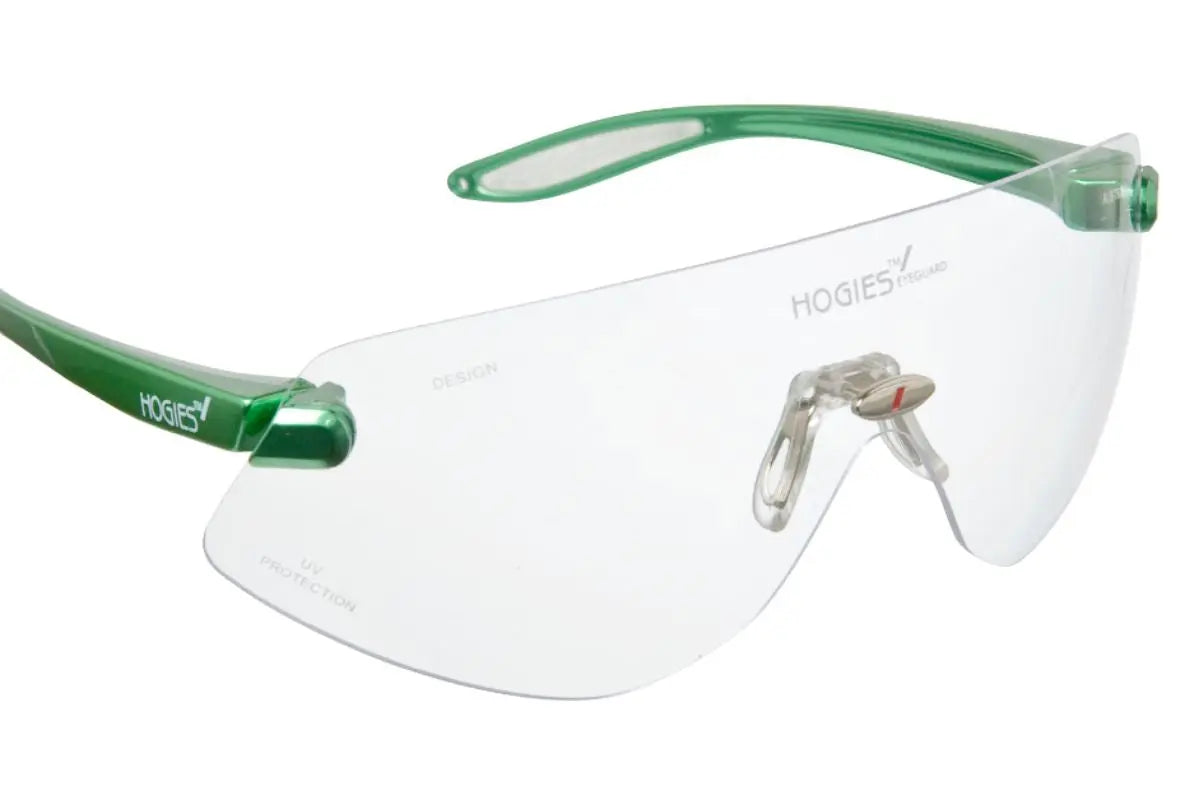
Performance eyewear is designed for movement, precision, and long hours of wear. Whether in sport, clinical environments, or industrial settings, it should remain stable, clear, and comfortable.
Yet most performance eyewear fails when exposed to real-world conditions.
Not because it lacks certification.
Not because it looks wrong.
But because it was never engineered for heat, movement, and sustained use.
Here is where most eyewear breaks down.
Why Fit Determines Eyewear Performance
Most eyewear is built around a single frame size and bridge shape. One width. One pressure strategy. One assumption about facial structure.
Human anatomy is not uniform.
When fit is incorrect, eyewear begins to shift. Slippage increases during movement. Pressure builds across the nose. Fogging becomes more likely because airflow is restricted. Stability relies on clamping force rather than structural balance.
Clamping harder does not create stability. It creates discomfort.
True performance eyewear distributes weight correctly and matches bridge geometry to the user. This is why size-specific performance eyewear systems perform more consistently in real conditions.
Fit is not cosmetic. It is structural.
If fit is wrong, performance suffers.
Why Fogging Is a Design Failure
Many brands treat fogging as a coating problem.
In reality, fogging is an airflow and thermal management issue.
Heat rises from the face. Moisture builds. Air becomes trapped behind the lens. Without proper airflow design, condensation is inevitable.
Anti-fog coatings can help, but if the frame design traps heat and restricts ventilation, coatings alone will not solve the issue.
Effective fog resistance requires:
-
Controlled airflow pathways
-
Balanced facial clearance
-
Reduced heat accumulation
-
Proper surface treatment
This is where hydrophobic lens technology becomes critical. When lens surfaces repel moisture and frames allow controlled airflow, fogging reduces naturally in both sport and professional safety environments.
Fogging is rarely a user error. It is usually a design compromise.
Why Optical Clarity Reduces Fatigue
Not all polycarbonate lenses deliver the same optical performance.
Lower-quality lenses often introduce peripheral distortion, uneven tint behaviour, or subtle colour imbalance. These issues may not be immediately obvious, but over time they increase visual strain.
In sport, this affects depth perception and reaction speed.
In clinical settings, it affects colour accuracy and precision.
In safety environments, it affects situational awareness.
Optical clarity in precision optical systems is not just sharpness. It includes distortion control, consistent light transmission, and stable colour perception.
When clarity is compromised, fatigue increases. And fatigue reduces performance.
Why Movement Must Be a Design Input
Most eyewear is tested statically. People are not static.
They run.
They lean forward.
They rotate their head.
They work under lights.
They sweat.
If movement is not part of the design process, stability depends on friction and tightness rather than engineered balance.
This leads to constant adjustment, uneven pressure, and long-term discomfort.
Well-engineered professional safety eyewear and performance sports systems are designed to remain stable during motion without relying on excessive clamping force.
If you have to keep pushing your glasses back into position, they are not designed for real-world use.
Why One Size Rarely Fits Properly
Production efficiency often drives brands toward a universal sizing approach.
But sizing affects:
-
Bridge alignment
-
Lens position relative to the pupil
-
Airflow behaviour
-
Peripheral protection
-
Weight distribution
When size is incorrect, every other performance factor is affected.
True performance eyewear recognises anatomical variation and offers adjustable systems that maintain correct optical positioning and long-term comfort.
Proper sizing is not a luxury feature. It is fundamental to stability and clarity.
What Real Performance Eyewear Requires
Real-world performance requires more than certification.
It requires:
-
Stability without excessive pressure
-
Optical clarity without distortion
-
Fog resistance without airflow compromise
-
Protection without unnecessary bulk
-
Comfort across extended wear
Performance eyewear should function as equipment. It should remove distraction, reduce fatigue, and support consistent visual integrity.
Equipment that distracts does not get worn.
Equipment that is uncomfortable gets removed.
And equipment that is unstable reduces confidence.
When eyewear is engineered around real use conditions rather than shelf appearance, the difference is measurable.
Fit becomes structural.
Clarity becomes reliable.
Stability becomes consistent.
That is what real-world performance demands.
Share:
How to Choose the Right Lens Tint for Sport