
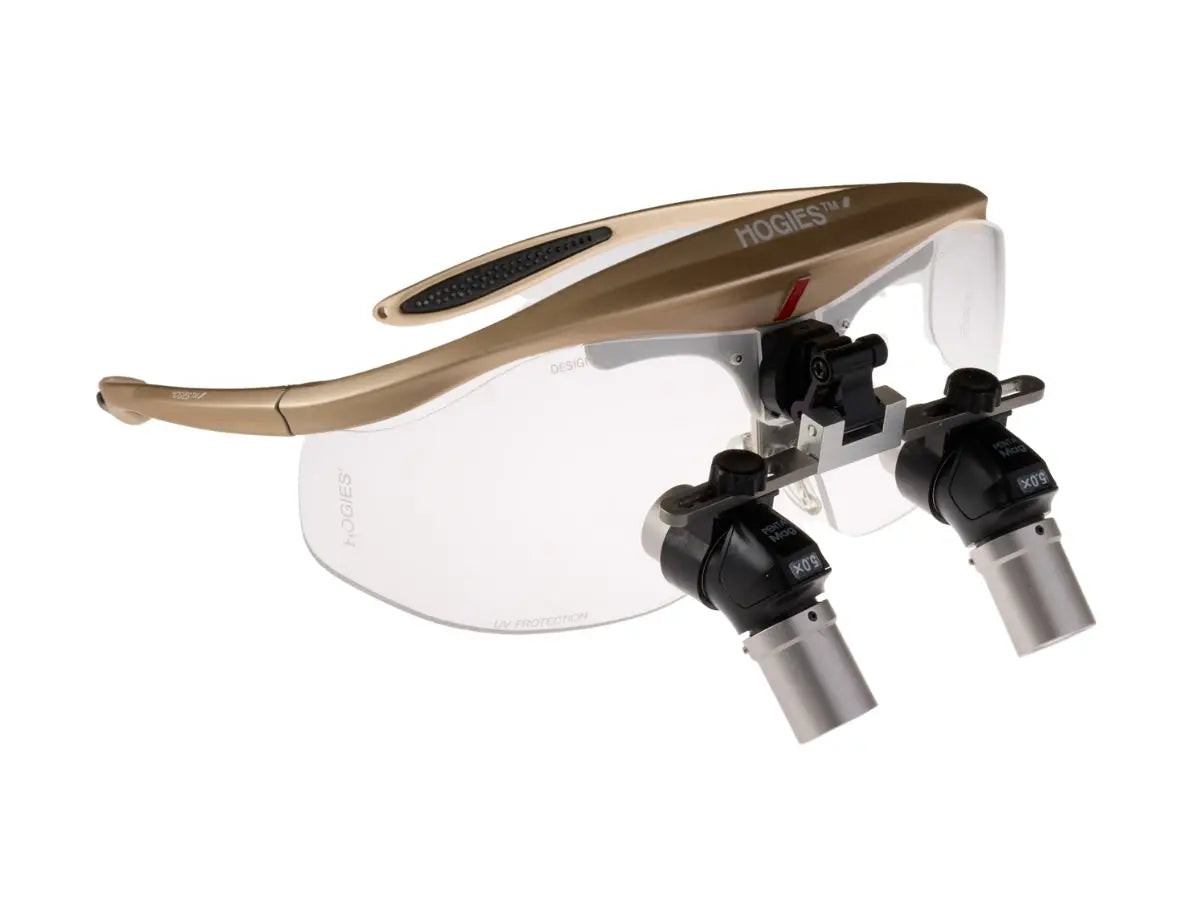
If you buy through-the-lens loupes today and your prescription changes in three years, the loupes have to go back to the manufacturer. The optical barrels are drilled directly into the carrier lens, so updating the script means rebuilding the pair, and the rebuild can shift working distance, alignment and angulation along with it. Flip-up loupes work differently. Because the optics sit on a hinge in front of the carrier, the correction can be changed on its own, either by wearing the loupes over your own glasses or by swapping a prescription lens carrier. Given that almost everyone needs reading correction from their early forties, this is worth thinking about before you buy rather than after. It applies the same way whether you work in dentistry, surgery or veterinary practice.
On this page
- Will my prescription actually change over the life of a pair of loupes?
- What happens to through the lens dental loupes when your prescription changes?
- How do flip-up loupes handle a prescription change?
- Are flip-up loupes heavier?
- Is TTL better for posture?
- Which loupes should you actually be looking at?
- Frequently asked questions
Will my prescription actually change over the life of a pair of loupes?
Almost certainly, and the research on this is not ambiguous.
Presbyopia, the gradual loss of near focus as the lens of the eye stiffens, is universal. A systematic review and meta-analysis published in Ophthalmology in 2018 estimated 1.8 billion people worldwide were presbyopic in 2015, a global prevalence of 25%, with 826 million of them experiencing near vision impairment because their correction was missing or inadequate (Fricke et al.). Symptoms typically begin between 40 and 45. It is not a condition some practitioners develop. It is one that everyone who lives long enough develops, and it progresses, so the near add keeps needing to increase through the forties and fifties.
Distance prescriptions move too, though more slowly than most people expect. The Blue Mountains Eye Study, a large Australian population cohort, measured refractive change over five years and found a mean shift of +0.41 D in people aged 49 to 54 at baseline, +0.30 D at 55 to 64, then a reversal toward myopia after 75 as nuclear cataract develops. The Beaver Dam and Gutenberg studies found the same pattern in other populations.
| Age at purchase | Typical five-year distance change | What it usually means in practice |
|---|---|---|
| Under 40 | Small and variable | Distance script fairly stable, presbyopia not yet a factor |
| 40 to 54 | Around +0.40 D | Near add begins and needs increasing every few years |
| 55 to 64 | Around +0.30 D | Near add continues climbing, distance drifts slowly |
| 65 and over | Small, then toward myopia | Cataract development can move the script in either direction |
Optometry Australia recommends a comprehensive eye examination at least every two years for all adults. Medicare subsidises one every three years for Australians under 65, and annually from 65, which is why three years is the interval most practitioners actually work to. Set either figure against loupes bought as a ten to fifteen year investment and the maths is the same. You will have your eyes tested several times over the life of the pair.

What happens to through the lens dental loupes when your prescription changes?
In a through-the-lens design the telescopes are mounted into the carrier lens itself, set to your interpupillary distance, working distance and declination angle at the time of manufacture. That construction is exactly what makes TTL light and stable. It is also what makes it difficult to update.
The people who teach dental ergonomics are direct about the consequence. Writing in Dimensions of Dental Hygiene, dental hygiene educator Claudia Turcotte notes that loupes need to be sent back to the manufacturer to change a prescription integrated with the carrier lens and telescope, and that updating it may cause changes to working distance, angulation and alignment. The optics have to be re-set into the new carrier, which is why the work happens at the factory rather than at a local optical lab.
Two practical costs follow from that. The first is the rebuild itself. The second is that your loupes leave your practice while it happens, and for anyone working magnified full time, that is not a small inconvenience.
It is worth being accurate about the exception. Some through-the-lens systems accept a removable prescription insert, which can be updated without a factory return. Turcotte notes those inserts may add weight to the loupes and increase the risk of fogging, so the convenience is not free, but it does mean a factory rebuild is not universal across every TTL pair on the market. It is a question worth asking before you buy, because the answer varies by manufacturer.
We should be clear about the evidence here. The presbyopia and refractive change data above come from peer-reviewed journals. The rebuild requirement is a different kind of claim. It is a mechanical fact about how the product is built, described consistently by manufacturers and by independent dental ergonomics educators writing in the professional press, rather than the subject of a controlled study. Nobody has run a trial on it because it is not really a research question.
How do flip-up loupes handle a prescription change?
The hinge that defines a flip-up loupe also separates the optics from the correction. That separation is the whole point.
There are two routes. The first is to wear the loupes over your existing glasses. The Hogies Prismatic range is designed to work exactly this way, so when your script updates you collect new glasses from your optometrist and nothing about the loupes changes at all.
The second is a prescription carrier. Every Hogies loupe frame is built around a magnetic platform, and the Rimless Magnetic Prescription Lens Holder clips straight onto it at $77. It accommodates most optical corrections. When your script changes you have new lenses fitted to the holder rather than sending your loupes overseas. The magnification, the working distance and the fit you were measured for stay exactly as they were.


Clips onto the magnetic platform on any Hogies loupe frame and accommodates most optical corrections. New script, new lenses, same loupes.
Declination angle is adjustable after purchase on the Hogies range as well, which matters if your posture or your chair setup changes over the years.
Are flip-up loupes heavier?
On raw grams, often yes. Flip-up optics sit forward of the carrier on a hinge, and that hinge adds mass a through-the-lens pair does not carry. It is the standard argument made against flip-up designs, and on the scales it is a fair one.
What matters when you are three hours into a list is not the number on the scales. It is where that weight sits. In most flip-up systems it sits on your nose, which is why practitioners describe pressure marks, redness and the small unconscious habit of pushing the frame back up all day.
Hogies loupes are engineered around that problem rather than around the number. An engineered support cord carries almost all of the weight across your head, so there is almost no pressure on the nose bridge and no red marks at the end of a long day. The bridge itself is a magnetic component you can change, so the profile is matched to your face rather than to an average one, and declination angle stays adjustable after purchase. You are not stuck with the fit you were handed.
That is the trade we made deliberately. We only sell flip-up loupes, whether they are being worn as dental loupes or as surgical loupes, because the flexibility is worth more across a working career than a few grams are, and because weight you cannot feel is not weight worth optimising for.
Is TTL better for posture?
This is the argument most often made for TTL, and the data does not support it as cleanly as you might expect.
Declination angle, the tilt of the optical barrels relative to your line of sight, is what lets you look down into the working field by moving your eyes instead of bending your neck. Sustained forward head tilt beyond roughly 20 to 25 degrees is repeatedly identified in the ergonomics literature as the trigger for chronic neck and shoulder problems in dentists, hygienists, surgeons and veterinarians alike.
This is not a vague concern. Writing in the peer-reviewed journal Decisions in Dentistry, Iwonka T. Eagle of the University of Michigan notes that many early through-the-lens loupes could not attain a declination angle greater than 30 degrees, and that clinicians commonly still work with the neck held at 20 to 30 degrees. Inadequate declination increases eye, head, back and neck strain, and can also leave the loupes out of coaxial alignment, which compounds the problem.
The useful question is not fixed versus flip-up. It is whether the barrel angle can be set to your anatomy, and adjusted again later as your posture or your chair setup changes. Optimal declination depends on individual facial anatomy, particularly nose height and the eye-to-ear reference line, so an angle preset at the factory to suit one practitioner will not suit the next.
Every Hogies loupe is flip-up, which means the barrels tilt and declination angle remains adjustable after purchase, whichever system you choose. A through-the-lens pair sets that angle once, at manufacture.
One caution from the ergonomics literature is worth carrying with you: what determines whether your posture is safe is your measured head tilt in your own chair, not the declination figure a brand advertises.

Which loupes should you actually be looking at?
Hogies builds a full range of dental and surgical loupes, every one of them flip-up, from a genuine entry point to high-magnification and ergonomic options. Dentists, hygienists, oral health therapists, oral and general surgeons and vets all work from the same range, because the frame platform and the magnification are chosen separately.
| System | Magnification | Price inc. GST | Suits |
|---|---|---|---|
| MiniScope Galilean | 2.5x and 3.0x | $770 | First loupes, students, hygiene and general work |
| MaximEyes Galilean | 2.5x and 3.0x | $1,400 | A step up in optics on the same frame platform |
| Keeler Galilean | 2.5x | $1,650 | Established optics, wide field of view |
| Keeler Hi-Resolution | 3.0x | $1,980 | Higher resolution for detailed restorative work |
| Prismatic | 3.5x to 6.0x | $2,900 to $3,850 | Endodontic and surgical detail, worn over glasses |
| ErgoPath | 3.0x to 7.2x | $3,000 to $4,000 | Practitioners who want to work with the head upright |
These are not ranked. They are different answers to different clinical preferences, and the right one depends on your magnification needs, your working style and your budget, not on which sits highest on the list.

Clear, bright magnification with a wide field of view, on the same magnetic MediView platform as the rest of the range. Free worldwide shipping.

Keeler optics on the Hogies MediView frame, with a generous field of view for a wide range of dental and surgical procedures.
Frequently asked questions
Can you put a prescription in flip-up loupes?
Yes. Either wear them over your existing glasses, or fit a magnetic prescription lens carrier to the frame. The Hogies rimless magnetic holder is $77 and accommodates most corrections.
Are these dental loupes or surgical loupes?
Both. The same flip-up systems are worn as dental loupes and as surgical loupes, and the choice between them comes down to magnification and working distance rather than discipline. Dentists and hygienists most often sit at 2.5x to 3.0x, while surgeons, endodontists and vets working at finer detail tend toward the Prismatic range at 3.5x and above.
Do through the lens dental loupes need to be remade when your prescription changes?
Usually, yes. Where the prescription is integrated into the carrier lens and telescope, the pair returns to the factory for the script to be updated, and the rebuild can affect working distance, angulation and alignment. Some TTL systems accept a removable prescription insert instead, which avoids the factory return, so it is worth asking the manufacturer which applies before you buy.
How often does a prescription change?
Optometry Australia recommends an eye examination at least every two years, and Medicare subsidises one every three years for Australians under 65. Presbyopia usually begins between 40 and 45 and progresses, so the near add typically needs increasing several times across the following two decades.
Are flip-up loupes worse for your posture than TTL?
Not inherently. What determines head tilt is the declination angle and whether it can be matched to your anatomy. A flip-up design keeps the barrel angle adjustable after purchase. A through-the-lens pair fixes it at manufacture.
Do flip-up loupes leave marks on your nose?
Not on a Hogies frame. The engineered support cord carries almost all of the weight across your head, so there is almost no pressure on the nose bridge and no red marks. The bridge profile itself is also a magnetic part you can change to match your face.
What is the cheapest way into a decent pair of dental loupes?
MiniScope Galilean at $770 is the entry point in the Hogies range, and free worldwide shipping applies to loupe orders.
If you already wear prescription safety glasses, the same principle applies there too. We covered it in Can you wear safety glasses with prescription lenses?
Buy loupes that can change when your eyes do
Every Hogies loupe is flip-up, built on the same magnetic platform, and designed to be adjusted rather than replaced.
 ErgoPath Ergonomic Loupes
A 45-degree deflection path for practitioners who prefer to work with the head upright, 3.0x to 7.2x.
 MediView Loupe Frame
Australian Design Award winning frame, compatible with Keeler, Heine, Surgitel and Zeiss Smart optics you already own.
24-month warranty on loupes and lights. Free worldwide shipping on loupe orders. Speak to Jason directly about a fitting.
Share:
Why Safety Glasses Fog and How to Prevent It Properly
Ergonomic Dental Loupes with Light: How to Choose the Right Pair