Choosing dental loupes with light comes down to five decisions: the magnification your procedures actually need, a working distance measured to your own posture, a light bright enough to work under without adding weight, a bridge that fits your face without sliding and a head position that will not leave your neck aching by mid-afternoon. Miss any one of these and it shows up in your neck, your eyes or your bank account. This guide walks through each decision so you can choose a pair of loupes, and a light, that hold up through a full clinical day.
1. Match the magnification to the procedure, not the marketing
Most general dental and hygiene work is comfortably covered by 2.5x to 3.0x magnification. It gives a wide field of view, forgives small head movements and is the easiest range to adapt to if this is your first pair of loupes. Restorative, endodontic and surgical work, where fine detail matters more than field width, generally moves practitioners up to 3.5x through 6.0x.
Higher magnification is not automatically better. A wider field at a lower power often gets more done, faster, than a narrow high-power field that forces you to reposition constantly. Choose the lowest magnification that lets you see what you need to see clearly.

2. Measure your working distance before you order
Working distance is the gap between your eyes and the patient's mouth when you are sitting or standing in your normal posture, not stretched forward to compensate for loupes that are too short. On most loupe systems, including every Hogies range, working distance is fixed at the point of manufacture rather than adjustable afterwards, so it needs to be measured accurately against your actual chair height and posture before you order, not guessed at.
A working distance that is too short forces you to hunch forward. Too long and you end up leaning back or squinting. Either way, the loupes end up fighting your posture instead of supporting it.
3. Decide between a wired and a wireless light
A wired light draws power from a belt-clip battery pack through a cable, which keeps the head-mounted weight to a minimum. A wireless (cordless) light carries its battery in the LED head itself, so there is no cable to snag, catch on a mask strap or limit how far you can turn from the patient.
The trade-off is weight. Cordless designs put more mass directly on the frame, so the battery and LED engineering matter more than they do on a wired setup. A well-built cordless head should still feel light through a full clinical day.

Three brightness levels up to 15,500 lux from a 14g LED head, with a 500-cycle battery and a dual charging cradle so a spare is always ready.
4. Decide whether you prefer a natural head tilt or to stay upright
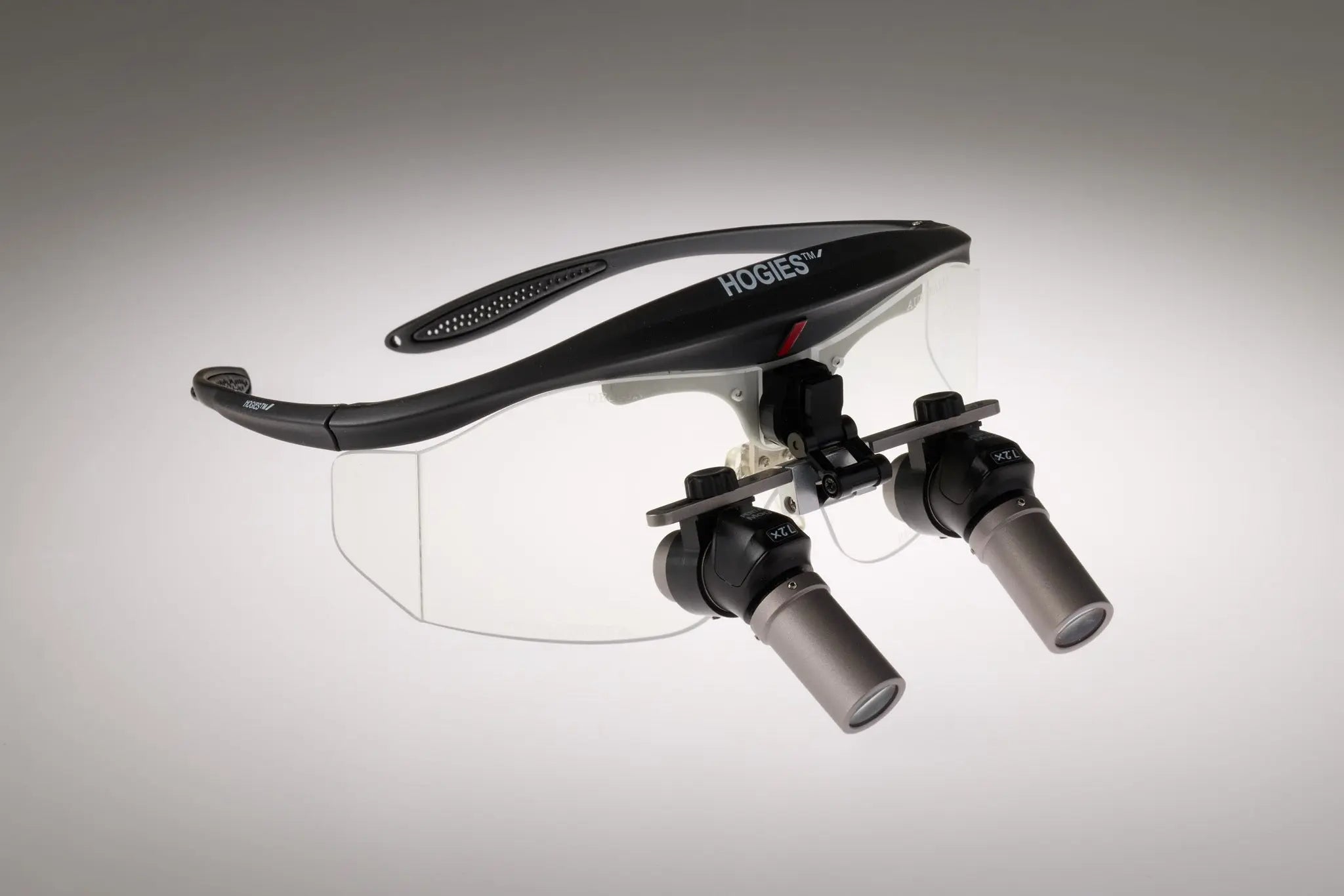
Hogies only sells flip-up loupes. Flip-up gives you the flexibility to adjust as your needs change and your practice evolves, which is why every range from MiniScope through to ErgoPath shares the same two working features: the optics flip up between patients without removing the frame, and the barrels tilt to fine-tune declination angle. That is true whichever range you choose.
Where the ranges differ is head position, and that comes down to preference rather than one being an upgrade on the other. MiniScope, MaximEyes, Keeler and Prismatic use the classic Galilean layout, where you tilt your head slightly forward toward the patient, the position most practitioners train on. ErgoPath uses a 45-degree deflection path built into the same flip-up mechanism, so you can work with your head closer to upright instead. Neither position is right or wrong. Head and neck posture is one of the most studied topics in dental ergonomics precisely because practitioners find comfort in different working positions (PLOS ONE, 2019), which is why Hogies makes both available rather than standardising on one.
| Loupe range | Head position | Frame weight | Who tends to choose it |
|---|---|---|---|
| MiniScope, MaximEyes, Keeler, Prismatic | Natural forward tilt (Galilean) | Varies by magnification | Practitioners who prefer, or are used to, tilting toward the patient |
| ErgoPath | Closer to upright (45-degree deflection) | Consistent 38g across 3.0x to 7.2x | Dentists, oral surgeons, hygienists, specialists and veterinarians who prefer to work upright |

A flip-up loupe built around a 45-degree optical path, for practitioners who prefer to work with their head upright. Available 3.0x to 7.2x, all at a consistent 38g frame weight.

5. Check the bridge fits your face, not just an average one
A loupe frame that slides down your nose mid-procedure is a working distance problem in disguise, because every millimetre it drops changes your focal point. Standard bridges are built around an average facial profile, which does not fit everyone. Hogies loupe frames use a magnetic, swappable nose bridge, including an Extended (Asian Fit) profile, so the bridge can be matched to your face rather than the other way around.
If you have been told your current loupes "just need adjusting" and they still slide, the bridge shape itself is usually the actual problem.
6. Work out what is actually included in the price
Advertised prices for dental loupes with light vary widely because they are not always pricing the same thing. Some quotes are for the loupe frame only, with the light, case and prescription lens fitting sold separately afterwards. Before comparing prices between suppliers, check whether the frame, the light and the case are all included in the number you are looking at, and whether a prescription lens insert is available if you need one.
Frequently asked questions
What magnification is best for dental loupes with a light?
For most general dental and hygiene work, 2.5x to 3.0x is the standard starting point, giving a wide field of view that is easy to adapt to. Restorative, endodontic and surgical procedures typically call for 3.5x or higher, where fine detail matters more than field width.
Is a wireless loupe light better than a wired one?
Neither is better outright. Wireless (cordless) lights remove the cable entirely, which some practitioners prefer for freedom of movement, but they carry the battery in the head itself so weight and battery engineering matter more. Wired lights keep the head lighter by moving the battery to a belt clip, at the cost of a cable to manage.
Are ergonomic (deflection) dental loupes worth the extra cost?
It depends on which head position you prefer, not on one design being better than the other. ErgoPath's 45-degree deflection path suits practitioners who prefer to work with their head upright. If you prefer, or are used to, the natural forward tilt of a classic Galilean loupe, MiniScope, MaximEyes, Keeler or Prismatic in the same magnification range covers that working style at a lower entry price. Both are flip-up designs built on the same underlying mechanism.
How much do dental loupes with an integrated light cost in Australia?
Entry-level Galilean loupe systems start from around $770 AUD for the frame, with integrated or add-on lights typically adding $1,100 to $1,650 AUD depending on whether it is wired or wireless. ErgoPath, Hogies' upright-position range, starts from $3,000 AUD for the frame at 3.0x magnification.
Can I add a light to loupes I already own?
In most cases yes, provided the light's mounting system is compatible with your existing frame. Check the coaxial adapter and mounting point on your current loupes against the light's specifications before buying, since this varies between manufacturers.
What is the difference between Galilean and deflection loupe designs?
Both are flip-up designs, and on both the optics flip up between patients without removing the frame and the barrels tilt to fine-tune declination angle. The difference is head position. A Galilean loupe has you tilt your head slightly forward toward the patient. A deflection design bends the optical path, commonly by 45 degrees, so you can keep your head closer to upright while looking at the same working field.
Ready to find the right fit
Working distance, bridge profile and magnification are measured to you, not guessed at.
ErgoPath Ergonomic Deflection Loupes
Flip-up loupes for an upright working position, through a 45-degree optical path. 3.0x to 7.2x.
LightView Cordless LED Headlight
Up to 15,500 lux, wireless, from a 14g head. Dual charging cradle included.
Prefer a natural forward tilt instead? The full Loupes range covers 2.5x to 6.0x across MiniScope, MaximEyes, Keeler and Prismatic, all flip-up.
Share:
Dental Loupes and Prescription Changes: What Happens When Your Script Updates?
Surgical Loupes in Australia: Flip-Up and Through the Lens Compared