
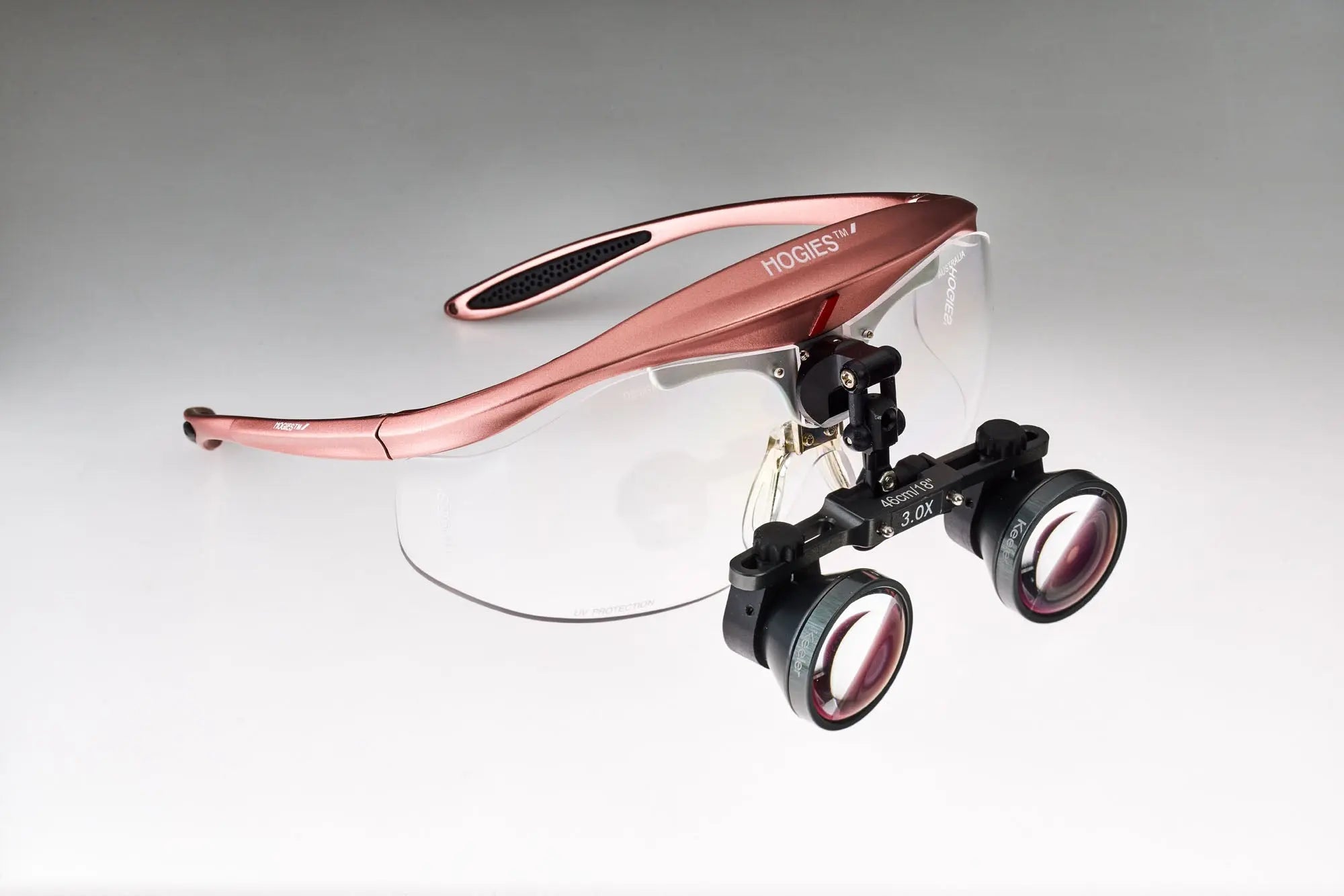
If you are choosing surgical loupes in Australia, the decision that matters most is not magnification. It is whether the optics are built into the lens in front of your eye or mounted on a hinge ahead of it. Through the lens loupes are made to your measurements and fixed there. Flip-up loupes keep the optics separate from the frame, so the fit, the correction and often the magnification stay adjustable after you have bought them. Both work. The question is which one still suits you in year eight, because a surgical career is longer than a pair of loupes usually gets credit for.
On this page
What does custom actually mean when you buy surgical loupes?
It is worth pinning this word down, because two very different things are sold under it.
The first is custom manufacture. Your interpupillary distance, your working distance and your declination angle are measured, and a through the lens pair is built to those numbers at the factory. It is made for you. It is also finished. Every one of those measurements is set in the carrier lens, and changing any of them later means the loupes go back to the manufacturer.
The second is custom fit. The measurements are still yours, but the fit stays adjustable. On a Hogies frame the nose bridge is a magnetic component you can swap for a different profile, declination angle can be reset after purchase, and the optics themselves lift off the magnetic platform.
Neither is dishonest. But if you are comparing quotes, it is worth asking which kind of custom you are being sold, because the word covers a pair fitted once and a pair that stays fittable.
The reason it matters more in surgery than in most fields is time. You may buy at 34 and still be operating at 58. Over that span your script will change several times, your table and chair setup will change, and the procedures you spend most of your list on will change too.

Flip-up or through the lens for surgical work?
Here is the honest comparison, including the one row where through the lens wins.
| Through the lens | Flip-up | |
|---|---|---|
| Optics | Set into the carrier lens | Mounted on a hinge ahead of the carrier |
| Worn over your own glasses | No | Yes |
| Prescription update | Usually returns to the manufacturer | Change your glasses or the lens carrier |
| Declination angle | Fixed at manufacture | Adjustable after purchase |
| Magnification change | New pair | Swap the optics on the platform |
| Between cases | Remove the loupes | Flip up, eyes free |
| Weight on the scales | Lighter | Heavier, because of the hinge |
| Where the weight sits | On the frame and your nose | Varies by design. Hogies carries it across the head |
Flip-up is heavier. That is the standard argument against it and on the scales it is fair. If someone tells you flip-up weighs more, they are right. What they are measuring is mass. What you notice through a long list is pressure, and on a Hogies frame those two are not the same thing.
What they are usually assuming is where that weight lands. In most flip-up systems it lands on your nose, which is where the pressure marks and the all day habit of pushing the frame back up come from. Hogies frames are built around an engineered support cord that carries almost all of the weight across your head instead. There is almost no pressure on the nose bridge and no red marks at the end of a list. The grams are real. The thing people actually object to is not.
What those grams buy you is that nothing is permanent. The flip itself is the part surgeons tend to notice first: you lift the optics, you have your unmagnified field and eye contact with the room, and you drop them again without breaking scrub or taking anything off your head.

Prismatic optics on the magnetic platform, worn over your own glasses. Free worldwide shipping on loupe orders.
What magnification do you actually need for surgical work?
Probably less than you are about to buy.
Magnification and field of view trade against each other, and so do magnification and depth of field. Every step up gives you more detail in a smaller window, and a field that is too narrow is harder to work in than one that is slightly too wide.
As a rough guide:
- 2.5x to 3.0x covers a lot of general surgery and most veterinary work. It holds the widest field and the broadest depth of focus, which matters when you are moving between the whole site and one spot in it.
- 3.5x to 4.0x is the versatile middle, and where many surgeons settle once they have worn loupes for a while. Detail without losing your bearings.
- 4.5x to 5.0x suits vascular, ENT, finer plastic work and endodontics.
- 5.8x and above is microsurgical territory, where the field is small anyway.
Those bands overlap, and specialty is a weaker predictor than people expect. Two vascular surgeons with the same list will often land a full step apart depending on how close they work and how much peripheral awareness they want. If you are buying your first pair, take the lower option of the two you are weighing up.
Across the Hogies range, Prismatic runs 3.5x, 4.5x and 6.0x and is built to be worn over your own glasses. ErgoPath runs 3.0x, 4.0x, 5.0x, 5.8x and 7.2x. Lower magnifications are available too. They all sit on the same magnetic platform, so the choice is about the work in front of you rather than about committing to a tier.

What happens when your prescription changes?
Almost everyone needs reading correction from their early forties, and the near add keeps increasing after that. So this is a question of when, not if.
On a through the lens pair where the correction is integrated into the carrier lens and telescope, the loupes go back to the manufacturer, and the rebuild can shift working distance, angulation and alignment. Some through the lens systems take a removable prescription insert instead, which avoids the factory return, so it is worth asking which applies before you buy.
On a flip-up pair the correction is simply separate. You either wear the loupes over your updated prescription glasses, or you have new lenses fitted to a magnetic carrier while the loupes stay exactly as they were measured.
We went through the evidence on this properly in Through the Lens Dental Loupes and Prescription Changes, including the refractive change data. The argument applies the same way in surgery.

Clips onto the magnetic platform on any Hogies loupe frame and accommodates most optical corrections. New script, new lenses, same loupes.
How do you stay upright through a long list?
Declination angle is the tilt of the optical barrels relative to your line of sight. It is what lets you look down into the working field by moving your eyes rather than bending your neck, and sustained forward head tilt is repeatedly identified in the ergonomics literature as the trigger for chronic neck and shoulder problems.
Writing in the peer-reviewed journal Decisions in Dentistry, Iwonka T. Eagle of the University of Michigan notes that many early through the lens loupes could not attain a declination angle greater than 30 degrees, and that practitioners commonly still work with the neck held at 20 to 30 degrees.
The useful question is not fixed against flip-up. It is whether the barrel angle can be set to your anatomy and reset later. Optimal declination depends on individual facial anatomy, particularly nose height and the eye to ear reference line, so an angle preset at the factory to suit one surgeon will not suit the next.
Every Hogies loupe is flip-up, so the barrels tilt and declination stays adjustable whichever system you choose. ErgoPath goes further and bends the optical path 45 degrees, for surgeons who prefer to work with the head upright through a long list.
One caution worth carrying: what determines whether your posture is safe is your measured head tilt at your own table, not the declination figure a brand advertises.


A 45-degree deflection path, available at 3.0x, 4.0x, 5.0x, 5.8x and 7.2x on the same magnetic platform.
Frequently asked questions
What are custom surgical loupes?
Usually it means a through the lens pair built to your measured interpupillary distance, working distance and declination angle at the factory. It is worth checking whether the fit stays adjustable afterwards, because a pair fitted once and a pair that stays fittable are both sold as custom.
Are flip-up surgical loupes heavier than through the lens?
On the scales, generally yes, because the hinge adds mass. Where that weight is carried matters more than the number. Hogies frames use an engineered support cord that carries almost all of it across your head, so there is almost no pressure on the nose bridge and no red marks.
What is the best magnification for surgical loupes?
For a lot of general surgery, 2.5x to 3.0x holds the widest field. Many surgeons settle at 3.5x to 4.0x, move to 4.5x to 5.0x for vascular, ENT and fine plastic work, and go higher again for microsurgical detail. Higher magnification narrows the field of view, so the lowest magnification that shows you what you need is usually the right one.
Can you wear surgical loupes over prescription glasses?
With a flip-up design, yes. The Prismatic range is built to be worn over your own prescription glasses, which is also why a script change does not affect the loupes.
Do surgical loupes come with a warranty in Australia?
Hogies loupes and lights carry a 24-month warranty, and free worldwide shipping applies to loupe orders.
Buy loupes that can change as your list does
Every Hogies loupe is flip-up, built on the same magnetic platform, and designed to be adjusted rather than replaced.
Prismatic Loupe System
Prismatic optics at 3.5x, 4.5x and 6.0x, worn over your own glasses.
ErgoPath Ergonomic Loupes
A 45-degree deflection path for working with the head upright, 3.0x to 7.2x.
24-month warranty on loupes and lights. Free worldwide shipping on loupe orders. Speak to Jason directly about a fitting.
Share:
Ergonomic Dental Loupes with Light: How to Choose the Right Pair
Prescription Safety Glasses vs RX Inserts: Which Is Better?