
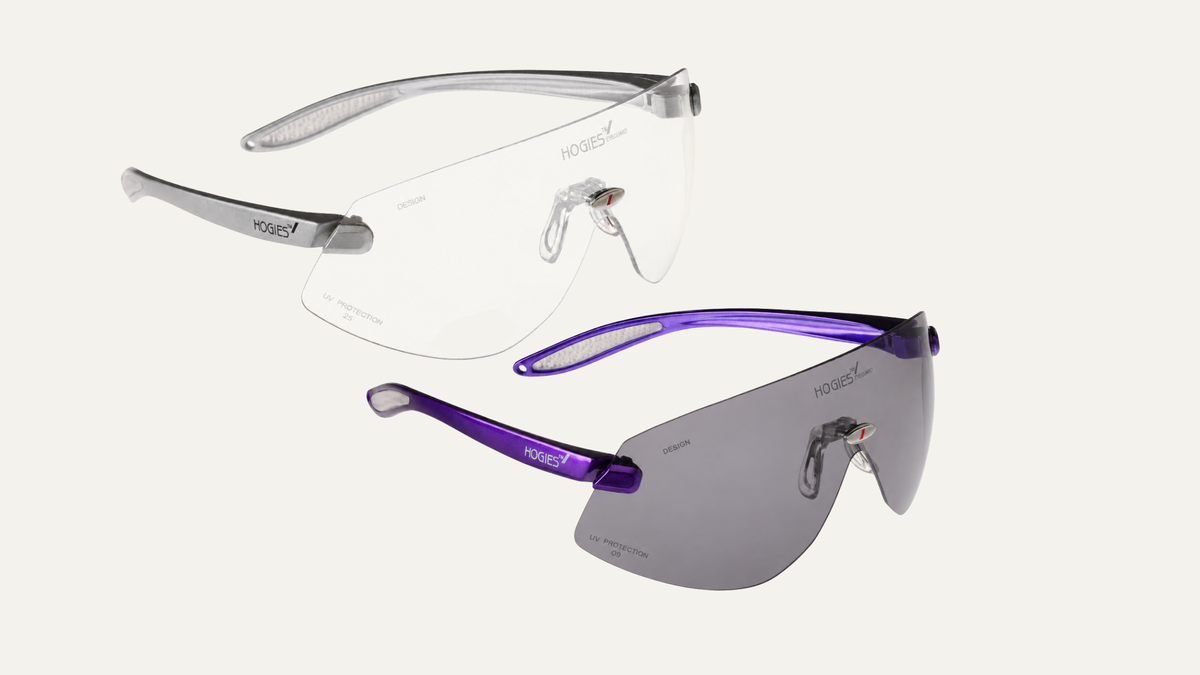
To choose pickleball glasses, make three choices in this order: your size, your bridge and your lens. Size and bridge decide whether the frame stays put through fast lateral rallies and stays off your cheeks. The lens decides how well you follow the ball in the light you play in. Colour and style come after that.
Most players start at the end of that list. This guide starts at the beginning.
What pickleball glasses need to do
Pickleball has you looking down at a ball at your feet, up at a lob and across at your partner, often inside the same rally. Good pickleball glasses do three things through all of it.
They stay put. A frame that shifts even slightly as you move pulls your attention off the ball.
They keep your view open. When you look up for a lob or an overhead, a rim across the top of the frame sits right in your sightline. A frameless lens leaves nothing above your eyes.
They stay clear. A warm face, a long session and a lens sitting close to the skin are the conditions fog likes.
All three come back to fit, not features.
Choice 1: your size
When you buy sports glasses you usually choose a colour and a tint. You rarely choose a size, because the frame usually comes in one.
That works if your facial profile sits near the middle of the range the designer had in mind. If it does not, the frame slips when you look down, sits loose or very tight at the temples and may shift when you move, or hold warm air against the lens.
EyeGuard Sports pickleball glasses come in three sizes:
| Size | Temple to temple | Frame weight | Suits |
|---|---|---|---|
| Kids (Micro) | 130mm | 24g | Children and smaller adult faces |
| Adult | 139mm | 26g | Most adults. Start here |
| Large (Macro) | 150mm | 31g | Very wide heads only |
Most adults wear Adult. Large is made for very wide heads, so only choose it if most glasses feel tight across your temples. If you are unsure, start with Adult. We will be very happy to exchange if they are not perfect.
For a 30-second check, hold a pair of glasses you already own against the size guide.

Most adults wear Adult. Every size comes with Low Bridge Fit or High Bridge Fit (Regular).
Choice 2: your bridge
Size is half of fit. The other half is how the frame sits on your nose.
EyeGuard Sports comes in two bridge designs.
Low Bridge Fit is designed for lower nose bridges and higher cheekbones. It sits the frame higher, so the lens stays off your cheeks.
High Bridge Fit (Regular) is designed for higher nose bridges.
Neither one is the default. They are two answers to two facial profiles. There are two quick ways to tell which is yours.
Check your bridge in a mirror. Look straight ahead and find the bridge of your nose, the point between your eyes where the nose meets the brow. If it sits level with or below your pupils, you have a lower nose bridge, so start with Low Bridge Fit. If it sits clearly above your pupils, start with High Bridge Fit (Regular).
Check what your glasses already do. If they slide down your nose through the day, or the lenses come to rest on your cheeks when you look down, that points to Low Bridge Fit. If most glasses already sit well on you, choose High Bridge Fit (Regular).
Three sizes across two bridges gives you six starting fits rather than one.
The squeeze, only if you need it
Not everyone needs to adjust the bridge. When you first try your glasses on, check whether the lens touches your cheeks. If it does not, you are done.
If it does, squeeze the bridge in a little, once. A metal insert sits inside the silicone bridge, so the frame lifts, the gap is restored and the insert holds the new position. It is not something you fiddle with between games.

For many people the right size and bridge are enough on their own. The squeeze is there for everyone else.
Why fit is also the anti-fog answer
The gap between the lens and your cheeks is not only about comfort. It is how the lens stays clear.
When the frame sits lifted off your cheeks, air circulates behind the lens. Warm air rising from your face has somewhere to go, so it moves past the lens rather than pooling behind it. A frame that rests on your cheeks traps that warm air against the lens.
This matters most at two moments. The first is when your body heats up: a long rally, a hot outdoor court or your third game in a row. The second is in air-conditioned halls, where a warm face sits close to a cool lens and that difference is exactly what makes a lens mist. In both, air moving behind the lens is what keeps your view clear.
No lens is immune to the room it is in. Walk from a hot car park into a chilled hall, or play in very humid air, and any lens can mist briefly until it adjusts to the room. What the right fit does is stop your own warmth from fogging it point after point.
Choice 3: your lens
Choose the lens for the courts you actually play on, not the one that looks best in the photo.
| Where you play | Lens | Why |
|---|---|---|
| Indoor halls and evening sessions | Clear | Lets the most light through. Nothing between you and the ball |
| Indoor sport, low light and overcast days | Orange | Increases contrast and depth perception when light is reduced, with a slight colour shift |
| Early morning and late afternoon, dim or dull light | Sodium Yellow | Increases contrast while keeping colours fairly natural. Not made for midday sun |
| Overcast skies and flat light | Vermillion | Sharpens detail for tracking the ball without heavily darkening your view |
| Mixed outdoor light, from hazy to bright | Brown | Adds contrast and definition |
| Bright outdoor sun | Grey | Cuts brightness evenly while keeping colours natural |
| Bright, exposed courts with reflective glare | Grey Revo Mirror | A grey lens with a mirror coating that reflects surface glare |
For more on how each tint behaves, see how to choose the right lens tint for sport.
Every lens also carries a hydrophobic coating. It repels water and resists smudges and fingerprints, so the lens wipes clean between games. That is a separate job from keeping fog at bay, which comes down to fit.
All lenses are UV400. The full tint range is on the Adult size. Large comes in grey, brown and clear, and Kids comes in grey, vermillion and clear.
If you play both indoors and out, a clear pair and a tinted pair covers every session with nothing to swap between games.
How clear is the lens?
The lens is one-piece spherical polycarbonate with UV400 protection, formed as a single curve with no join or seam to bend what you see. The clear lens has been independently tested at a NATA accredited laboratory, and its measured figures sit well inside the limits rather than scraping past them.
- Haze, the scattered light that softens edges and makes your eyes work harder to pick up a fast ball, measured 0.2 to 0.7% against a 3.0% ceiling.
- Colour recognition scored 1.00 to 1.01 against a 0.80 minimum, so the lens is effectively not shifting the colours you see.
- UV transmittance measured under 0.1% from 280 to 380nm.
These figures were measured on the clear lens.
Why the lenses are not polarised
This is deliberate. Polarising filters can affect depth perception and show dark patches through some court glass. When you are judging a fast ball at the kitchen line, you want the lens to change how bright things look, not how far away they seem.
Check your own fit in about ten seconds
Put on the glasses you wear now and stand in front of a mirror.
Look down sharply, the way you would at a ball dropping at your feet. Do not touch the frame. Watch whether it moves.
Then check the gap. Is the bottom of the lens resting on your cheek, or is there space between them?
If the frame moved, or the lens is touching your cheek, you are wearing the wrong size or the wrong bridge. On court that shows up as constant small adjustments and a lens that clouds when you are working hard.
Pickleball glasses or goggles?
Players use both words for the same job. Strapped pickleball goggles hold firmly but can feel warm and enclosed over a long session. Glasses-style pickleball eyewear is lighter and more open. With EyeGuard Sports, curved temples and removable anti-slip ear grips do the holding, without a strap around your head. In particularly fast, active games, add the lanyard cord for extra security.
If you wear prescription glasses
Everyday frames tend to slip during play and their rims sit inside your field of view. The EyeGuard RX Prescription Insert clips in behind the lens on Adult and Large sizes, so your prescription sits in a sports frame that stays put.

Clips in behind the lens on Adult and Large sizes, so your prescription sits in a sports frame that stays put.
What to ask before you buy any pickleball glasses
- How many sizes does the frame come in? One size means the brand has already decided your face is average.
- Is the nose bridge adjustable? A bridge you can squeeze once, if needed, finishes the job that sizing starts.
- Does the bridge come in more than one design, and what is the second one for?
- Is there anything across the top of the frame when you look up?
- Does the fit hold in movement? Look down, turn your head quickly and see what the frame does.
- Is the tint right for the courts you play on most?
Finding yours
EyeGuard Sports pickleball glasses come in Kids, Adult and Large, each with Low Bridge Fit or High Bridge Fit (Regular), seven lens tints and 14 frame colours. That gives you six starting fits, plus a one-time squeeze if you need it.
They are designed in Melbourne by Hogies, a family business that has been making eyewear for more than 60 years, and they work just as well for padel, squash and tennis as on a pickleball court.
Find your size, bridge and lens →
Pickleball glasses fit questions
How should pickleball glasses fit?
They should stay still when you look down sharply, leave a small gap between the bottom of the lens and your cheeks and sit comfortably at the temples without pressing.
What size pickleball glasses do I need?
Most adults wear Adult (139mm temple to temple). Choose Kids for children and very small adult faces (130mm). Large (150mm) is for very wide heads only, so choose it only if Adult feels tight across your temples.
Do I need different glasses for indoor and outdoor pickleball?
Many players keep two pairs: clear for indoor halls and evening play, and grey, brown or Grey Revo Mirror for outdoor sun. One tinted lens can feel dark indoors, and a clear lens leaves you squinting in full sun.
Share:
TTL Dental Loupes? 6 Questions to Ask Before You Order (and Why Flip-Up Answers Them)