
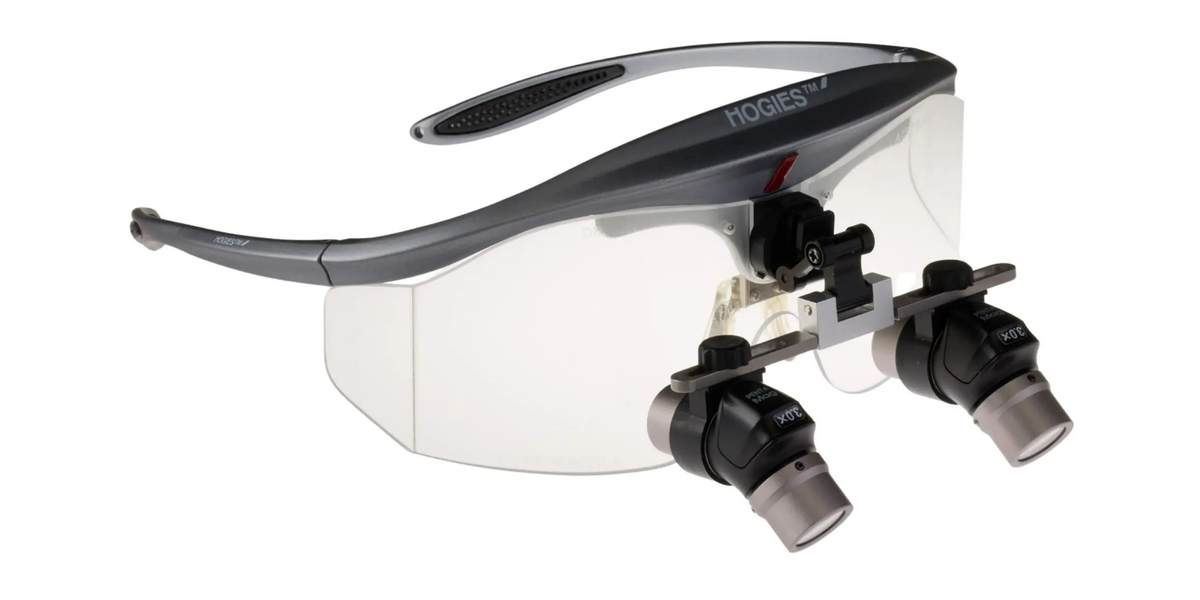
Your eyes will change. Before you order through the lens (TTL) dental loupes, ask what happens to them when it does. Will they need to go back in a box to the manufacturer? That is the first of six questions worth answering before you sign. A flip-up design has a clear answer to five of them, and the sixth (weight) has a fair answer you should hear before you decide.
The reason those questions matter so much for dentistry is hours. A surgeon puts loupes on for a case and takes them off between cases. You put yours on before your first patient and they are still on your face at four o'clock. A practitioner working four clinical days a week is in loupes for around 1,400 hours a year, across a career long enough for your eyes to change more than once.
TTL vs flip-up dental loupes at a glance
| The question | Through the lens | Flip-up |
|---|---|---|
| 1. When your eyes change | Usually back to the manufacturer | New lenses in the magnetic carrier, not new loupes |
| 2. Between patients | Take the loupes off | Flip up, frame stays on |
| 3. Declination angle | Fixed at manufacture | Adjustable after purchase |
| 4. Weight on the scales | Lighter | Heavier, because of the hinge |
| 5. Wrong magnification or working distance | Built into the lens | We change it for you |
| 6. Time to delivery | Built to order, often months | ErgoPath dispatches in roughly three weeks |
Shaded cells show where each design has the edge. Here is the reasoning behind every row.
1. What happens to my loupes when my eyes change?
Nobody's eyes stay the same. Jason Hogan's father, Martin, was a spectacle maker with a shop on Collins Street in Melbourne, and he saw the same faces come back through the door year after year with a script that had moved again. Almost everyone needs reading correction from their early forties. If you do not wear a correction yet, you will. Across a dental career this is a question of when, not if, and it is the cost nobody quotes you when you buy.
On a TTL pair your correction is ground into the same lens your magnification sits in. You cannot just replace the lens, so the pair usually goes back to the manufacturer for a rebuild, and you work without them while you wait. Some TTL systems take a removable prescription insert instead, so ask which applies before you order.
On a flip-up pair the optics sit on a hinge in front, so your correction stays where it belongs. Every Hogies loupe takes a magnetic prescription carrier. When your eyes move, you put new lenses in the carrier: new lenses, not new loupes. If where you work allows it, you can also wear the loupes over your own glasses. Either way, nothing goes back to a factory. We went through the research in Dental Loupes and Prescription Changes.


Your correction sits in the carrier, behind the optics. A new script means new lenses in the carrier, not new loupes.
2. What do I do with my loupes between patients?
Between patients you are changing gloves, writing notes, checking a screen, turning to your assistant and talking to the person in the chair. With TTL loupes the optics are set into the carrier lens, so the only way to clear them from your eyeline is to take the whole frame off your head. Do that dozens of times a day and a lot of people stop bothering.
With flip-up loupes you lift the optics, you have your unmagnified view and eye contact with your patient, and you drop them again without anything leaving your face. Consent discussions and checking in with an anxious patient both land better without telescopes in the way.

3. Can the declination angle be changed after I buy?
Declination angle is the downward tilt of the optical barrels relative to your line of sight. It decides whether your eyes look down into the mouth or your neck does the work instead. Sustained forward head tilt is repeatedly identified as a trigger for chronic neck and shoulder pain, and dentistry is one of the professions where it shows up most.
The numbers make the point. In measurements published by B.J. Chang in Oral Health Group, practitioners wearing traditional TTL loupes with declination angles of 22 and 24 degrees worked with their heads tilted 33 to 36 degrees. An ergonomic TTL with a steeper 35 degree barrel brought head tilt to 20 degrees. An adjustable flip-up barrel at 45 degrees brought it to 9.
Plenty of TTL loupes are built with a good angle. The question to ask is whether that angle can be reset later. Your ideal angle depends on your anatomy and on how your chair and posture change over a career. A TTL angle is set at the factory. Every Hogies loupe is flip-up, so the barrels tilt and declination stays adjustable whichever system you choose.
ErgoPath approaches posture from another direction too. It bends the optical path 45 degrees, so the optics look down while your head stays upright. That is a working preference rather than a tier.


A 45 degree optical path for upright posture, flip-up between patients, 3.0x to 7.2x. Dispatches in roughly three weeks.
4. Where does the weight sit by four in the afternoon?
This is the row where TTL wins, and it deserves a straight answer. Flip-up loupes weigh more on the scales, because the hinge adds mass. If a TTL supplier tells you that, they are right.
What you notice at the end of a list, though, is pressure rather than mass. In most loupes the weight lands on your nose, which is where the red marks and the all day habit of pushing the frame back up come from. Hogies frames are built around an engineered support cord that carries almost all of the weight across your head instead. There is almost no pressure on the nose bridge and no red marks at the end of the day.
5. What if the magnification or working distance turns out to be wrong?
On TTL loupes the magnification is bonded into the prescription lens, so a pair that turns out wrong is a pair you live with or rebuild. On a Hogies flip-up pair nothing is locked in. If the magnification turns out not to be what you needed, we change it. If the working distance does not suit you, we change that too. How that happens depends on where you are, so talk to us.
Every step up in magnification shows more detail in a smaller window. As a rough guide for dental work:
- 2.5x covers hygiene, examination and most of a general list, with the widest field and the most forgiving depth of focus.
- 3.0x to 3.5x is where a lot of general and restorative practitioners settle after a year or two.
- 4.5x suits endodontics, fine restorative and crown margin detail.
- 5.0x and above is specialist territory.
If you are weighing up two options, take the lower one. You can move up later.

Keeler optics on the Australian Design Award winning MediView frame. 2.5x for the widest field, Hi-Res 3.0x for sharper margin detail.
6. How long until I am wearing them, and what does it cost to start?
TTL loupes are built to your measurements at the factory, and lead times are commonly quoted in months rather than weeks. If you are a final year student starting clinic early next year, or a new graduate with a start date, ask for the lead time in writing before you sign. ErgoPath dispatches in roughly three weeks.
MiniScope runs 2.5x and 3.0x from $770, and a 10% student discount applies across every Hogies loupe. If you are not sure where to start, Jason runs loupe fittings in person at our Burwood studio in Melbourne or remotely.


Flip-up dental loupes with a wide field of view, built for hygiene, general work and your first years in clinic.
Frequently asked questions
Are TTL or flip-up loupes better for dentists?
It depends on how you work, but the case for flip-up is strongest in dentistry because loupes are worn all day. Flip-up separates your prescription from the loupes, lets you clear the optics between patients without removing the frame and keeps declination angle adjustable after purchase. TTL is lighter on the scales.
What are the disadvantages of flip-up loupes?
Flip-up loupes weigh more than TTL because of the hinge, and the hinge needs wiping down between patients as part of your infection control routine. On a Hogies frame the weight is carried across the head by a support cord rather than on the nose bridge.
How much do dental loupes cost in Australia?
The Hogies range runs from $770 for MiniScope to $4,000 for ErgoPath 7.2x, with Keeler Galilean at $1,650 and $1,980. Students receive 10% off every Hogies loupe, and loupe orders ship free worldwide.
Which loupe magnification is best for a dental student?
2.5x is the usual starting point. It gives the widest field and the most forgiving depth of focus while you are learning to work at a fixed distance. You can move up to 3.0x or 3.5x later.
Can you wear dental loupes over prescription glasses?
With a flip-up design, yes. Every Hogies loupe takes a magnetic prescription carrier, and Prismatic loupes are built to be worn over your own glasses where your clinic allows it.
For more on choosing an angle and a light, read Ergonomic Dental Loupes with Light, or browse the full Hogies dental loupes range.
Loupes that adjust as your practice does
We only sell flip-up loupes. Flip-up gives you the flexibility to adjust as your needs change and your practice evolves.
24 month warranty on loupes and lights. Free worldwide shipping on loupe orders. 10% student discount on every Hogies loupe. Talk to Jason about a fitting: jason@hogies.com or +61 3 9650 9163.
Share:
Glasses Keep Slipping Down Your Nose? 6 Fixes and the One Cause They All Miss
How to choose pickleball glasses that fit your face