
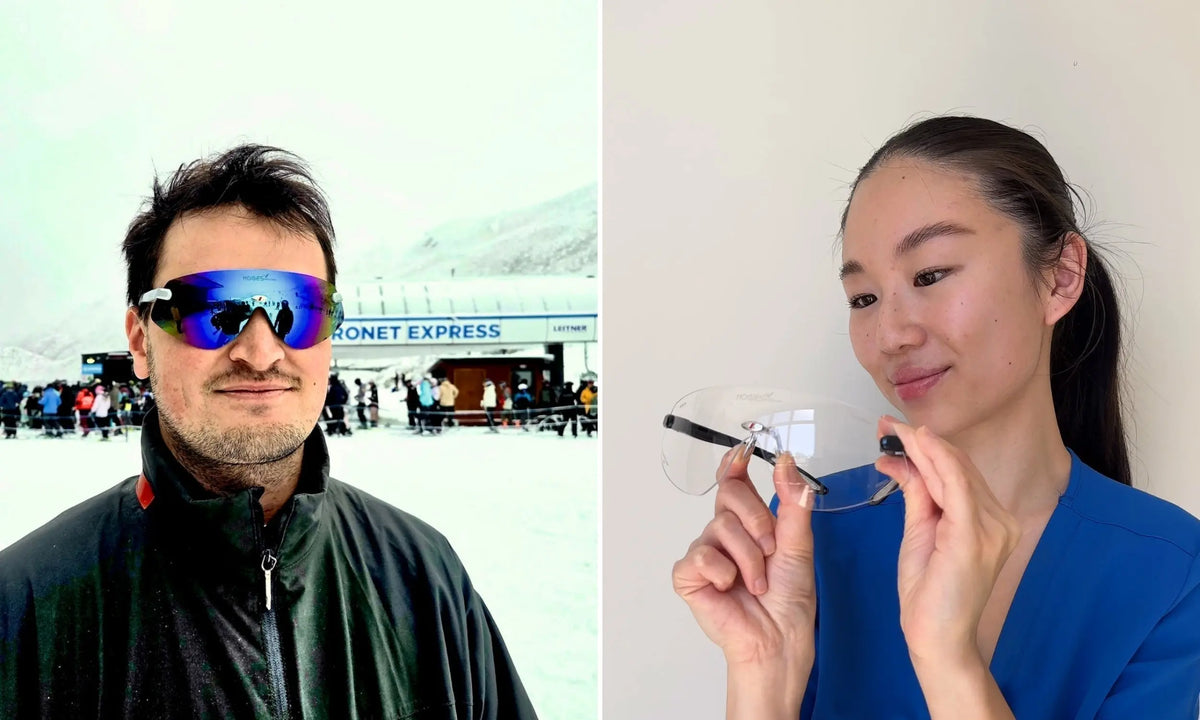
Glasses slip down your nose for one of two reasons. Either the frame has loosened and needs adjusting, or the frame was never built for the height of your nose bridge in the first place. The first is a five minute fix. The second is not, and it is the one almost nobody mentions, which is why people still spend the day frustrated and pushing their glasses back up.
Below are six fixes worth trying on the glasses you already own, an honest note on what each one can and cannot do, then the cause sitting underneath all six, how to check it on your own face in about ten seconds, and what a frame actually built for your nose bridge does differently.
- Why do glasses slide down your nose?
- Six fixes for the glasses you already own
- The one cause those six fixes cannot reach
- Two bridge designs, and neither one is the standard
- Two people with the same bridge height, two different noses
- A starting shape, not a finished one
- What the right fit actually buys you
- What if you wear prescription glasses?
- Frequently asked questions
Why do glasses slide down your nose?
A frame rests on three points: the bridge of your nose and the two arms behind your ears. The nose carries most of the weight. The arms stop the frame tipping forward. When all three are doing their job, the frame stays where you put it.
Four things commonly stop that happening.
- The hinge screws have loosened, so the arms no longer grip
- The arms were never bent to the shape of your head
- Skin oil and sweat give the frame less to hold onto, which is worse in heat and humidity, and worse under a mask
- The frame's bridge is a different height to your own
You can fix the first three yourself, or in ten minutes at an optical counter. The fourth is the one that makes the other three feel temporary. You tighten the screws, it holds for about two weeks, then you are back to pushing them up.
Six fixes for the glasses you already own
1. Tighten the hinge screws
The small screws at the arm hinges work loose over months of opening and closing. Tightening them means hunting down one of those tiny screwdrivers from a glasses repair kit, or dropping the frame back in to wherever you bought it. Neither takes long. Both are a nuisance, and you will be doing it again.
2. Have the arms bent to your head
The arms should follow the curve behind your ear with a slight downward bend at the tip. Many optometrists will do this in a few minutes at no charge. Acetate arms need warming first, so this is worth leaving to someone with a frame warmer rather than a hairdryer.
3. Adjust the nose pads
If your pads sit on small movable arms, squeezing them closer together lifts the frame higher on your nose. This is the only fix on this list that changes where the frame sits rather than how hard it grips. The catch is that plenty of frames have their pads or bridge moulded straight in, and those do not move at all.
4. Add ear hooks or temple grips
Soft sleeves that slide onto the arms and sit behind your ear. Cheap, easy, and visible if that bothers you. They hold the arms steadier, but they do not change where the frame sits on your nose.
5. Clean the bridge and your skin
Oil, sweat and sunscreen build up where the frame sits and give it less to hold onto. Wiping the frame and your nose midway through the day does more than people expect.
6. Use a cord or strap for active work
For sport, trades or anything where you are moving fast or looking down, a cord takes the frame out of the equation entirely.
| Fix | What it changes | How long it holds |
|---|---|---|
| Tighten hinge screws | Arm tension | Weeks to months, then repeat |
| Bend the arms | Arm grip and angle | Months, until knocked out of shape |
| Adjust nose pads | Frame height | Lasting, if your pads sit on movable arms |
| Ear hooks | Grip behind the ear | While they are fitted |
| Clean bridge and skin | Grip at the nose | Hours |
| Cord or strap | Removes reliance on fit | As long as you wear it |
Look at the middle column. Five of the six change how hard the frame grips. Only one changes where the frame sits, and even that works only if your pads sit on arms that move. Moulded bridges with nothing to adjust are common across safety and sports eyewear, and on those there is nothing to raise.
That is where the real cause shows up. It is also why EyeGuard is built in two bridge designs rather than one, each with a silicone bridge you squeeze in to set the last of the fit yourself. Which of the two is yours comes down to something you can see on your own face.
The self-check takes about ten seconds, and it tells you which of the two designs is built for your face.
The one cause those six fixes cannot reach
Your nose bridge has a height. The frame's bridge has a height. They have to match.
Here is the check, and it works whether or not you currently wear glasses. Look at yourself side on, or at a photo taken from the side, and find where the bridge of your nose sits in relation to your pupils. Level with them or lower generally indicates a lower bridge. Above them generally indicates a higher one.
A frame built for a higher bridge, worn on a lower one, has less to rest against. It drops until it finds somewhere to sit, which is usually further down the nose or on the cheeks. No amount of screw tightening changes that, because the problem is not tension. It is height.
It costs you more than the nuisance of pushing them up. A frame that has slid down sits against your cheeks, which closes the gap that air needs to move through, so it fogs sooner. In heat and humidity that happens faster. It also shifts every time you look down, which is the moment you most need it still.
If you have spent years assuming glasses simply do not fit your face, this is usually the reason, and it is worth saying plainly that there is nothing unusual about your face. A lower nose bridge is common across East Asia, which is why the eyewear industry built a fit for it in the first place. It is not confined to any one region either, because bridge height varies from person to person everywhere. A frame built for a higher bridge has very little to rest on, however well it is made, so it slides. The answer is a frame built for the height you actually have.

Two bridge designs, and neither one is the standard
Safety and sports are each built in the same two designs, and which one you want follows from the check you just did.


Low bridge fit (lower nose bridge, higher cheekbones)
Engineered to keep the frame lifted off the cheeks, so the lens sits clear and the frame has something to hold onto.
High bridge fit (higher nose bridge)
The frame rests on the nose and holds there, keeping the lens clear of the cheeks.
Neither is the default and neither is the fallback. They are two separate engineering decisions for two different sets of faces, and you pick the one that matches yours.
If you already wear glasses, the quickest check is how they behave. Look down, or smile. If your glasses slide down, or the lenses come to rest on your cheeks, the low bridge fit is the one to try.
 EyeGuard Safety Glasses, Adult, Low Bridge Fit
For lower nose bridges and higher cheekbones. Certified, 26 grams, and adjustable to your own nose.
Shop low bridge fit EyeGuard Safety Glasses, Adult, High Bridge Fit
For higher nose bridges. Same certification, same weight, same adjustable bridge.
Shop high bridge fitAlso in Micro and Macro sizes. Not sure which is yours? The bridge fit guide walks you through it.
Two people with the same bridge height, two completely different noses
This is where most fit advice stops, and where it quietly goes wrong.
Bridge height tells you which design to start from. It does not tell you the whole story, because height is only one of the things that varies between faces. Noses also differ in width, and in projection, meaning how far the bridge stands out from the face. Two people can sit at the same bridge height and have almost nothing else in common: one narrow, one broad, one flatter, one more prominent.
So bridge height alone cannot decide a fit. Every low nose bridge is different. So is every high one. A pair that sits perfectly on a friend or a colleague is not automatically right for you, even when you would both describe your bridge the same way.
Which is why both designs adjust. The one you choose is the starting point, not the finished fit, and the last part of it is yours to set.
A starting shape, not a finished one
If the lens is touching your cheeks, squeeze the bridge in a bit. That is it. Once. A metal insert inside the silicone bridge holds the shape you set, so it stays that way. A fit that is yours rather than an average.
That is the part that answers the problem above. The two designs cover the difference in height between faces. The squeeze covers the difference in width and projection. Three sizes across two bridge designs gives you six starting points, and you tune whichever one you choose to your own nose.
What the right fit actually buys you
Fit is not only about the frame staying put, though that is the reason people go looking.
Air moves
A frame sitting clear of your cheeks leaves a gap, and that gap lets air move, which means less fogging even with body heat. Certified protection is unaffected either way. If fogging is the main thing bothering you, we have gone deeper on it in why safety glasses fog and how to prevent it properly.
It stays put during quick head turns and when looking down
Quick head turns during sport and head-down work both show poor fit first, whether that is over a patient, on a court or at a workbench. Three things hold it steady: a rounded temple shape, the adjustable medical-grade silicone nose bridge, and removable anti-slip grips on the arms.
You stop noticing them
EyeGuard weighs 26 grams, and weight that sits where it was meant to sit is weight you forget about.
EyeGuard safety glasses are certified to AS/NZS 1337.1:2010 under StandardsMark licence SMK1492, held by Hogies Australia and originally certified in 1995. You can check it yourself on the public SAI Global register. The lens also meets CE EN 166, with EN 170 for UV. Both bridge designs carry the same certification, so choosing the fit that suits your face costs you nothing in protection.

The same two bridge designs and the same adjustment, with a lens tint to match the conditions. Choose your nose bridge on the product page.
Choose your bridgeWhat if you wear prescription glasses?
Then the same logic applies, and we should be straight with you: Hogies makes certified safety eyewear and sports eyewear, not prescription frames. If your everyday glasses slide, ask your optometrist for a frame in a low bridge fit rather than another set of grips. The term is standard across the industry and opticians will know exactly what you mean.
If the slipping pair is the one you wear for work, and you need certified protection over or instead of it, we have compared the options in prescription safety glasses vs RX inserts.
Frequently asked questions
Why do my glasses slip down my nose?
Usually one of four things: loose hinge screws, arms that were never bent to your head, oil and sweat at the bridge, or a frame whose bridge is a different height to yours. The first three are adjustments. The fourth is a fit mismatch, and it is the one that makes the other fixes feel temporary.
How can I stop my glasses slipping down my nose?
Start with the free fixes: tighten the hinge screws, have the arms bent behind your ears, and clean the bridge and your skin during the day. If it keeps happening after all three, the frame is probably built for a different bridge height than yours, and the fix is a different frame rather than another accessory.
Is low bridge fit the same as Asian fit?
Low bridge fit is the term the eyewear industry uses for what is often sold as Asian fit. We use it because it describes the face rather than a nationality, and because bridge height varies widely within every population. A lower nose bridge is common across East Asia, and plenty of people of European descent have one too. The check is the same either way: look at where your bridge sits in relation to your pupils, and if it is level with them or lower, start with the low bridge fit.
Why do I constantly have to push my glasses up?
Because the frame is not resting where it was designed to rest. It finds its own level a little lower down your nose, you push it back, and gravity repeats the exercise. Check your bridge height against your pupils, side on, before buying another grip.
Is it normal for glasses to slip?
A small amount of movement over a long day is normal, particularly in heat and humidity. Constant slipping is not. It is a fit problem, and it is worth solving rather than living with.
Are there glasses that do not slide down?
There are glasses built for the height of your nose bridge, which is what stops the sliding. Look for a brand that offers more than one bridge design, and ideally one you can fine-tune yourself, since two people with the same bridge height can still have very different noses.
How do I know if I have a low nose bridge?
Look at your face from the side and find where the bridge of your nose sits relative to your pupils. Level with them or lower generally indicates a lower bridge. Above them generally indicates a higher one. Bridge width is separate and varies independently, which is why an adjustable bridge matters as much as the right starting design.
Stop pushing them up
Check your bridge against your pupils, choose the design built for it, then squeeze it in to finish the fit. Two bridge designs, three sizes, across safety and sports.
Find your bridge fitDesigned and dispatched from Australia. Over 60 years of Hogan family eyewear.
Share:
Padel vs Pickleball: 7 Real Differences and Which One to Try First
TTL Dental Loupes? 6 Questions to Ask Before You Order (and Why Flip-Up Answers Them)