
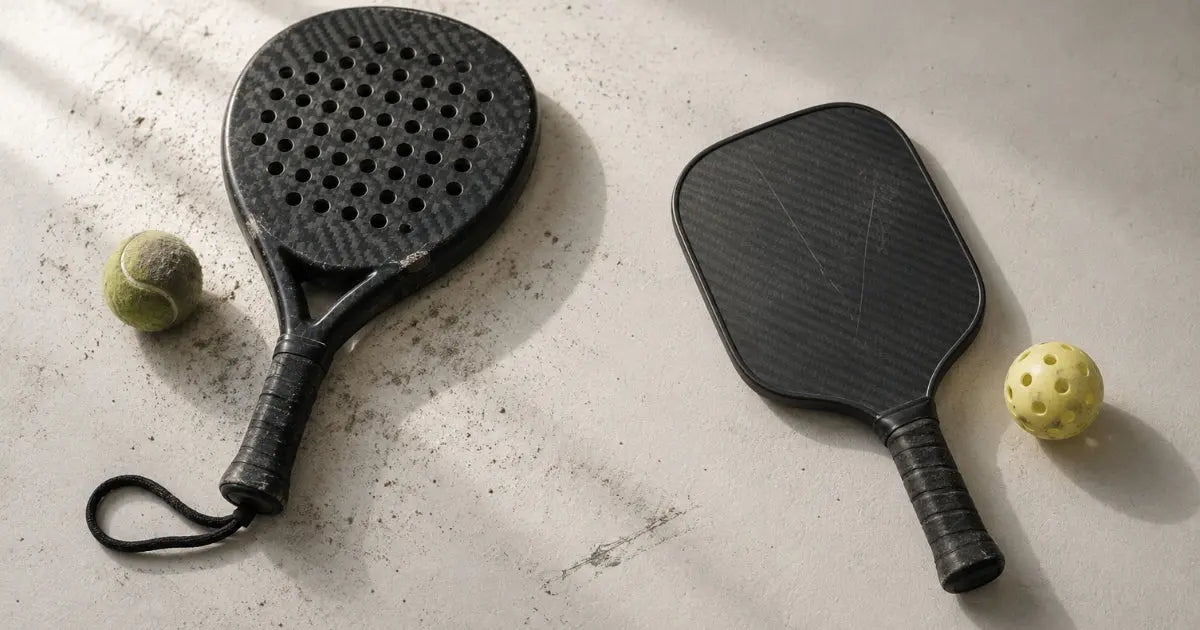
Padel and pickleball are the two fastest-growing racket sports in the world and they are constantly confused, but they are not versions of the same game. Padel is doubles played inside a glass-walled court measuring 20m by 10m (66ft by 33ft), where the walls are part of the rally, using a solid stringless racket and a slightly depressurised tennis ball. Pickleball is played on an open court measuring 13.4m by 6.1m (44ft by 20ft), with a perforated plastic ball, a flat paddle and a no-volley zone at the net.
The short answer, and it holds in most countries: pickleball is easier to learn and far easier to find a court for, while padel has the steeper learning curve and the longer, more tactical rallies. Try pickleball first if you want to play this week, padel first if you have a tennis or squash background and a venue near you.
Here is how they compare on everything that decides which one you book, with Australia and New Zealand as the worked example on the one point that changes by country.
 A padel court is a glass box. A pickleball court is a rectangle. Almost every other difference follows from that.
Padel vs pickleball at a glance
| Padel | Pickleball | |
|---|---|---|
| Court | 20m x 10m (66ft x 33ft), enclosed by glass and mesh | 13.4m x 6.1m (44ft x 20ft), open |
| Walls | In play, the ball can be played off them | None |
| Ball | Depressurised tennis ball | Perforated plastic |
| Bat | Solid perforated racket, no strings | Flat solid paddle |
| Format | Almost always doubles | Singles or doubles |
| Scoring | Tennis scoring, 15, 30, 40, game | First to 11, win by two |
| How you get on court | Book and pay for a purpose-built court | Often existing club or council courts |
| Time to a decent first game | A few sessions | Most of one session |
1. The walls are the whole difference
Everything else follows from this. In padel the ball stays live after it hits the glass, so a shot that beats you can rebound off the back wall and hand you a second chance. Rallies run long, the tactics look more like squash than tennis, and much of the game is patience rather than winners.
Pickleball has no walls. Once the ball passes you the point is over, which makes it sharper and far more about reflexes at the net. It is also why padel courts cost so much more to build, and why there are far fewer of them.
2. The ball and the bat are not interchangeable
A padel ball is a tennis ball with slightly lower pressure, so it bounces less and travels fast off a solid racket. A pickleball is a hollow perforated plastic ball, closer to a wiffle ball, and it slows noticeably in the air.
That gap shows up on a radar gun. The fastest pickleball hit ever ratified by Guinness World Records sits just under 100 km/h (about 62 mph). A padel smash travels considerably faster, which is why radar units sold for padel coaching are calibrated to more than double that.
Neither bat has strings. A padel racket is thick, heavy and perforated. A pickleball paddle is flat, light and usually carbon fibre.
3. Padel is doubles, pickleball is your choice
Padel is doubles almost everywhere. Singles courts exist but most venues do not have one, so padel clubs are built around turning up alone and being paired up. Pickleball works as singles or doubles, so it flexes to whoever you can round up.
4. Pickleball is quicker to learn, padel is quicker to enjoy badly
Pickleball is the easier start. Small court, slow ball, underarm serve, and most people are rallying properly inside their first session. The two rules that trip beginners up are the double-bounce rule and the kitchen, the no-volley zone that stops you camping at the net.
Padel takes longer, because the walls take longer. Reading a rebound is a skill no other racket sport teaches. The upside is that padel is fun well before you are good at it, because the walls keep rallies alive.
5. Where you can actually play near you, and this is the real decider
For most people this settles it, and the answer depends entirely on where you live. The good news is that the pattern is the same almost everywhere, so you can work out your own answer quickly.
Pickleball spreads on courts that already exist. A pickleball court fits inside a tennis court and needs little more than lines and a net, so clubs, councils and schools can add it cheaply. That is why pickleball turns up in small towns and why participation climbs so steeply once it arrives.
Padel needs a purpose-built glass structure. Nobody converts their way into a padel court. Somebody has to fund and build it, so padel arrives in cities first and spreads outward slowly, which makes it a metro sport in every market that is early in its curve.
The practical test wherever you are: search for courts within a reasonable drive of you before you get attached to either sport. If both exist near you, this article's other six differences decide it. If only one does, that is your answer.
Australia and New Zealand, as the worked example. Pickleball in Australia has gone from under a thousand association members at the end of the 2010s to tens of thousands of registered players across several hundred clubs, almost all of it on existing council and tennis courts. New Zealand runs the same pattern through Pickleball New Zealand, with playing groups across both islands. Padel is concentrated and new in both: Padel Australia operates under Tennis Australia and the national court count only recently passed a hundred, while New Zealand is earlier still with fewer than thirty courts and Auckland well ahead of everywhere else. Melbourne, Sydney, Perth, Brisbane, the Gold Coast, Auckland, Wellington and Christchurch have padel venues. Much beyond that and you are driving.
So the honest answer here is pickleball, clearly, on players, on clubs and on your odds of finding a court nearby. Padel is growing faster from a much smaller base, and the gap is closing rather than closed. If you are reading this from the UK, Europe or the Middle East, expect the reverse: padel arrived there first and is far ahead of pickleball.
The numbers, as they stand
Everything above holds year to year, and the underlying pattern holds in most markets. The figures below are specific to Australia and New Zealand and they move, so they live here rather than through the article.
| Padel | Pickleball | |
|---|---|---|
| Australia, courts or clubs | 100 or more courts, up 40% year on year | 425 clubs |
| Australia, registered players | Not separately reported | 27,974 |
| Australians who have played | More than 90,000, up 50% year on year | About 155,000 in a year |
| New Zealand, courts or clubs | 28 courts across 10 clubs in six regions | Playing groups nationwide, no published total |
| New Zealand, players | About 3,000 | Not published |
| Average member age | Not reported | Mid fifties |
Australian padel: Padel Australia, December 2025. Australian pickleball: Pickleball Australia Association and AusPlay, to June 2026. New Zealand padel: Kiwi Padel, June 2026. Pickleball New Zealand does not publish a national membership figure. Last reviewed September 2026.
6. The two sports cost differently, not just differently priced
This is a difference in model, which is why it holds even as rates change.
Pickleball mostly runs on courts that already exist. Club membership plus access to council or club courts keeps the per-session cost low, paddles are inexpensive, and much of the play is organised socially rather than booked commercially.
Padel is a booked, paid, purpose-built court. A padel court is an engineered structure with glass walls, so the venue has to build it and recover the cost. You book by the hour and split it four ways, peak costs more than off peak, and most venues sell memberships that make regular play cheaper.
Neither is expensive by the standards of a booked indoor court. But one is a habit you fall into through a club, and the other is a booking you make.
7. The difference nobody writes about: what each sport asks of your eyes
Every other comparison stops at courts, bats and rules. The two sports also put genuinely different demands on your vision, which is worth knowing before you buy anything to wear on court.
Padel is played looking up, and through glass. It is an overhead-heavy game. You track lobs against a ceiling or an open sky, then pick the ball up again off the back glass, sometimes from behind you. Where you first see it is often the far edge of your vision rather than the middle. Padel venues also switch lighting constantly: outdoor daylight, floodlights, indoor LED, and plenty of clubs run more than one.
Pickleball is played lower, faster and more often in full sun. The exchanges that decide points happen at the net, close and quick, and a great deal of pickleball worldwide is played outdoors at the brightest part of the day. Glare off the court surface matters more than it does inside a padel cube.

Two things follow, and they are why regular players end up in sports eyewear rather than street sunglasses.
The first is tint. Clear is right for indoor and night courts, a tint earns its place outdoors, and if you play both you will want both. Our guide to choosing the right lens tint for sport goes through it properly.
The second surprises people: polarised lenses are the wrong tool here. Polarisation cuts glare off water, wet roads and snow, which a court has little of, and what it costs you is depth perception and ball tracking. On a padel court it does something odder still. A polarising filter makes the internal stress in tempered glass visible as dark bands or faint rainbow patterns, and padel walls are tempered glass you look through all game.

One piece of polycarbonate curved edge to edge, so no frame sits in your side vision. Three lens sizes, two bridge fits, clear or tinted, and not polarised.
Fit matters as much as lens. Glasses that shift when your head goes back are a different problem from glasses that shift when you run, and padel is the sport that finds it. If your pair slides, the cause is usually the bridge, not the lens, which we covered in why glasses keep slipping down your nose. Nose bridges come in more than one shape for the same reason lenses come in more than one size, so it is worth working out which bridge fit suits your facial profile before you buy anything.
So which should you try first?
Try pickleball first if you want to play this week, you are not near a padel venue, or you want the cheapest start. The average association member is in their mid fifties and just over half are women, so the club scene is welcoming to beginners.
Try padel first if you have played tennis or squash, you live near a metro venue, and you prefer long tactical rallies to quick reflex exchanges.
Try both if you can. Most people who do say padel scratches the tactical itch and pickleball is the one they can always find a game of.
Frequently asked questions
Is padel easier than pickleball?
No. Pickleball is easier to learn: smaller court, slower ball, and most beginners rally properly within one session. Padel takes longer because reading the ball off the glass walls is a skill no other racket sport teaches.
Which is more popular, padel or pickleball?
It depends entirely on where you are. Pickleball leads in Australia, New Zealand and North America. Padel leads across Spain, much of Europe, Latin America and the Middle East, where it arrived far earlier. In Australia and New Zealand specifically, pickleball is ahead by a clear margin on registered players and clubs, while padel is growing faster from a much smaller base.
Do you need special glasses for padel or pickleball?
Not to start. Regular players tend to move on from street sunglasses for two reasons: courts switch between indoor and outdoor lighting so one tint rarely covers both, and sports frames are built to stay put through overheads and fast direction changes.
Are polarised sunglasses good for racket sports?
Generally no. Polarised lenses cut glare reflected off water, roads and snow, which a court has little of, and they can reduce the depth cues you use to track a ball. On a padel court they also make the stress patterns in the tempered glass walls visible.
Playing both? You will want both lenses.
Clear for indoor and night courts, a tint for outdoors. Three lens sizes and two bridge fits, so you start from a shape that suits your facial profile.
EyeGuard Lightweight Sports Glasses, Adult
Independently lab tested and certified to AS/NZS 1337.1:2010 and CE EN 166 Optical Class 1, with optical clarity measured across the full lens.
Shop EyeGuard Sports →Designing eyewear in Australia since the 1960s. 30 day returns.
Share:
Prescription Safety Glasses vs RX Inserts: Which Is Better?
Glasses Keep Slipping Down Your Nose? 6 Fixes and the One Cause They All Miss