
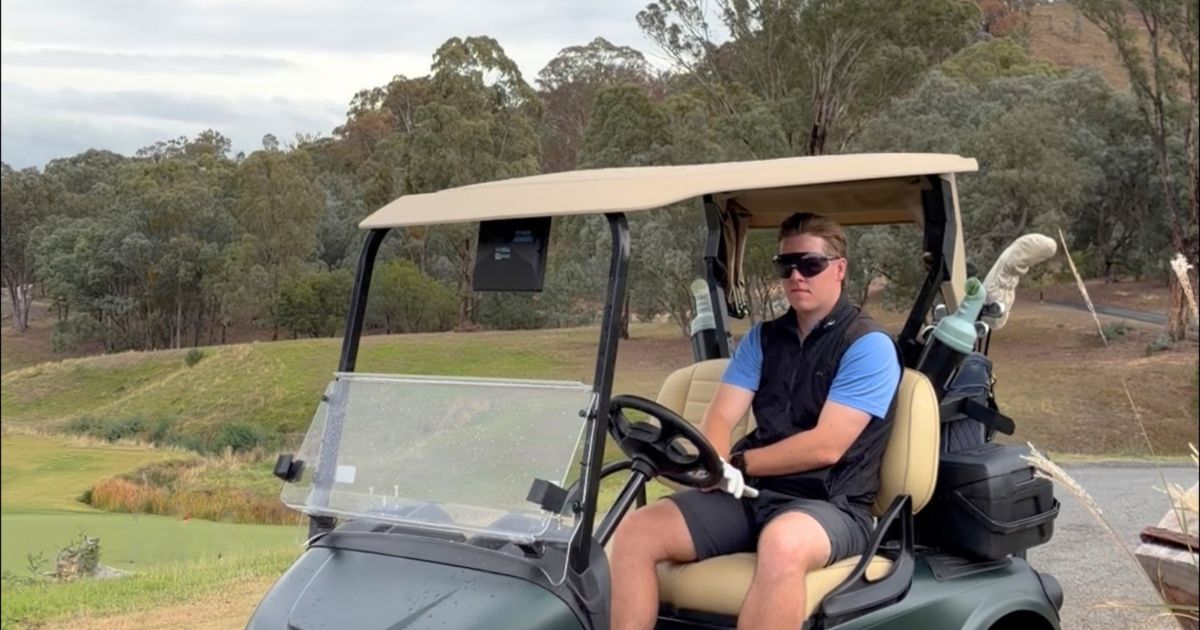
The best lens tint for golf sunglasses is brown for most rounds, vermillion for overcast or flat light and grey for very bright days. Tint is half the decision. The other half is fit: golf sunglasses should stay where you put them when you look down at the ball, so they must cater for different nose bridges. EyeGuard Sports has options designed for you, whether you need the Low Bridge (Asian) Fit or the Regular Fit. Five quick checks below tell you whether a pair stays put.
A round can take many hours, and the light changes through it, from a low sun at an early tee time to flat cloud on the back nine. This guide covers which tint suits which light, where polarised lenses fit in and how to check the fit with your own hands before you commit.
What is the best lens colour for golf sunglasses?
Choose the tint for the light you play in most. Brown suits most rounds, so start there. Vermillion and grey cover the days brown does not.
| Light on the course | Lens | Why it works |
|---|---|---|
| Most rounds, from hazy to bright | Brown (our pick) | Adds contrast and definition, which helps you pick out the ball against the sky and read changes across the green |
| Overcast skies and flat light | Vermillion | Sharpens detail for tracking the ball without heavily darkening your view |
| Very bright sun | Grey | Cuts brightness evenly while keeping colours natural |
| Early tee times, late afternoon and dull light | Sodium Yellow | Increases contrast while keeping colours fairly natural. Not made for midday sun |
Brown lenses filter blue light and enhance reds and greens, which is why many golfers pick them for telling the shades of a green apart. Grey is the choice when glare is the main problem, because it keeps colours natural rather than boosting contrast. Vermillion is the tint for grey days, when the ball is harder to follow.


EyeGuard Sports lenses are fixed, so a second pair, not a lens swap, covers a change in light. A sensible pairing is brown as the everyday pair and vermillion for flat days. Our lens tint guide covers every tint in the range.
26 grams, a one-piece frameless spherical lens and UV400 lenses in brown, vermillion, grey and more. Every tint comes in both Low Bridge (Asian) Fit and Regular Fit.
$44.00 Choose your fitShould golf sunglasses be polarised?
It is partly a matter of preference, but it is important to consider that polarised lenses alter depth perception. EyeGuard Sports is not polarised, on purpose. We left the polarising filter out. A polarising filter cuts reflected light. On a green, some of that reflected light is the sheen that shows you which way the grain runs.
Glare control and UV protection are separate jobs. All EyeGuard Sports lenses are UV400. Glare is handled by tint density: our grey lenses are 85% density and our brown lenses are 65% density, and some golfers like the Grey Revo Mirror (Adult size) for extra glare reduction. Whatever you buy, check the label: Cancer Council advises that some fashion styles give no real UV protection.
How should golf sunglasses fit? Five checks
A frame that shifts at address pulls your attention off the ball, and a lens resting on your cheeks holds warm air against it. Two things set the fit: size and nose bridge. Each check below takes about a minute.
1. The head-down check
They stay put because you choose the fit that suits your nose bridge, and the bridge also adjusts: when your glasses arrive, squeeze it once if you need to for your face, and a metal insert holds that fit from then on. Silicone comfort and a frame built to stay put through a full swing do the rest. To test it, put the glasses on, look down sharply as if at a ball at your feet and do not touch the frame. If the frame moves, the fit or the size is wrong. Harry, a +1 golfer, puts it this way: "No, they have never slipped. Even when I've got my head down over the ball, they're perfect."

2. The cheek gap check
Look from the side in a mirror. The lens should sit off your cheeks, so that as your body heats up, air circulates behind it. If the lens touches your cheeks when you first try the glasses on, squeeze the bridge once and the metal insert holds the new position.

3. The nose bridge check
Nose bridges differ more than frame sizes do, so EyeGuard Sports comes in two fits for different nose bridges. One suits a lower nose bridge and higher cheekbones and holds the frame higher. The other suits a higher nose bridge. Neither is the default, and both are the same price. Our nose bridge guide shows how to tell which suits you, and glasses that keep sliding are usually a bridge problem: see why glasses keep slipping down your nose.
4. The size check
| Size | Temple to temple | Weight | Suits |
|---|---|---|---|
| Adult | 139mm | 26g | Most adults. Start here |
| Kids | 130mm | 24g | Junior golfers and smaller facial profiles |
| Large Adult | 150mm | 31g | Very wide heads only |
Most adults wear Adult. Large Adult is for very wide heads only, and it comes in grey, brown and clear. The size guide walks through the measurements.

The same one-piece lens and two fits for different nose bridges, made for very wide heads. Grey, brown and clear.
$44.00 See Large Adult5. The swing check
Turn your head through a practice swing, then look up as if following the ball. The frame should stay where you put it. At 26 grams, Adult is light enough to forget about immediately.
Can you wear golf sunglasses with a prescription?
Yes. EyeGuard Sports is not designed to go over prescription glasses, so the answer is the EyeGuard RX Prescription Insert. It is a lightweight, rimless insert that clips into the frame, so your own prescription sits inside your sports glasses. It fits Adult and Large Adult, in both fits. Reference lenses are included for your optometrist, or Hogies can organise the prescription lenses for you.
"I wear prescription glasses, so I used to play golf with my prescription sunglasses. Which, look it was okay, but they slipped and they fogged. So needless to say, I found the answer."
Sarah, a golfer who wears prescription glasses
What do golfers say about EyeGuard Sports?
We asked two golfers about their rounds in EyeGuard Sports. These are their words.
"The brown tinted ones are my favourite. They help me distinguish the different parts of the green."
Sarah, on the brown tint
"The yellow tint's perfect for early tee times. Brings out the edges, the corners, the contrast of the greens."
Harry, a +1 golfer, on the Sodium Yellow tint
Which golf sunglasses should I choose?
Start with brown, in the fit that passes the head-down check, and add vermillion if flat light is common where you play. A hard case is worth adding: it protects the lens in your bag between rounds.

A zip hard case that keeps your glasses protected in your golf bag between rounds.
$9.90 See the hard caseGolf sunglasses questions
What lens colour helps you see the golf ball?
Brown adds contrast and definition, which helps you pick out the ball against the sky and read changes across the green. In overcast or flat light, vermillion sharpens detail for tracking the ball without heavily darkening your view.
Which is better for golf, UV or polarised?
They do different jobs. UV protection is about the ultraviolet light that reaches your eyes, so look for a UV400 rating on the label. A polarising filter cuts reflected glare, and whether you want one is partly personal preference. EyeGuard Sports is UV400 and is not polarised.
What is the difference between Low Bridge (Asian) Fit and Regular Fit?
They are two fits for different nose bridges. Low Bridge (Asian) Fit suits a low nose bridge and higher cheekbones and holds the frame higher so the lens stays off your cheeks. Regular Fit suits a higher nose bridge. Neither is the default, and both are the same price.
Is there a golf sunglasses size for juniors?
Yes. The Kids size is 130mm temple to temple and 24g, in grey, vermillion and clear, with the same two fits for different nose bridges.
Where can I buy EyeGuard Sports golf sunglasses?
Direct from Hogies. EyeGuard Sports is $44 in Adult, Kids and Large Adult, designed in Melbourne and dispatched from Australia. See the EyeGuard Sports golf page for the full range.
Find your tint and your fit
EyeGuard Sports comes in Adult, Kids and Large Adult, with two fits for different nose bridges and a lens for every kind of light on the course. Every size and tint is $44.
See the golf rangeDesigned in Melbourne by Hogies, a family business with more than 60 years in eyewear.
Share:
Hiking Sunglasses: Which Lens Tint Is Best, Plus 5 Checks So They Stay Put on the Trail