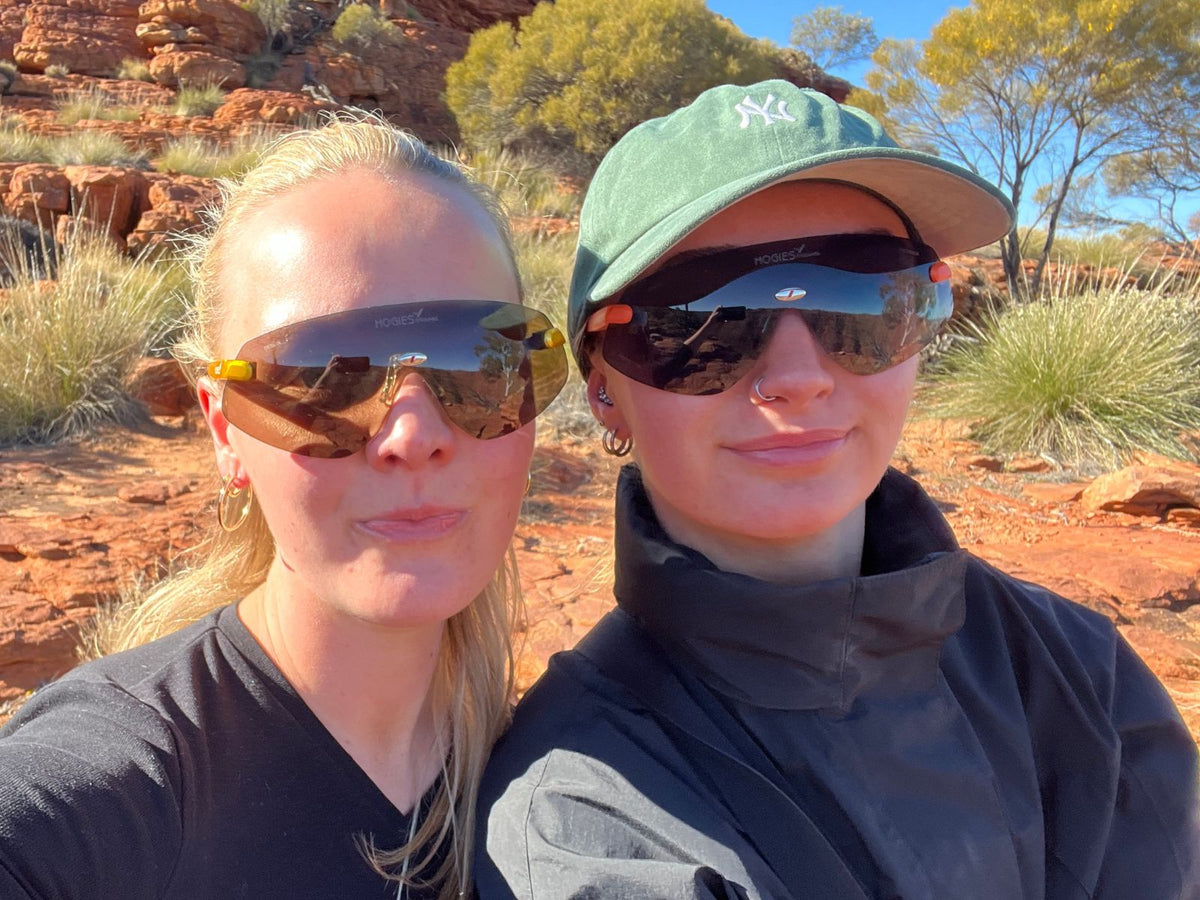
The best lens tint for hiking sunglasses is grey for bright, open country and brown when the light moves between sun and shade, with a Revo mirror lens for very bright, exposed ground. Tint is half the decision. The other half is fit: hiking sunglasses should stay where you put them when you look down at your footing, and five quick checks below tell you whether a pair will.
A day on the trail can start before dawn and finish in flat afternoon glare, with open ridgelines and dense bush in between. This guide covers which tint suits which light, whether you need sunglasses at all, where polarised lenses fit in and how to check the fit with your own hands before you commit.
What is the best lens colour for hiking sunglasses?
Choose the tint for the light you walk in most. Grey and brown cover the widest range of hikes. The other three suit particular conditions.
| Light on the trail | Lens | Why it works |
|---|---|---|
| Bright sun and open country | Grey | Cuts brightness evenly while keeping colours natural |
| Light that shifts between sun, shade and bush | Brown | Adds contrast and depth, which helps you pick out detail on the ground |
| Very bright, exposed ground such as desert, open ridgelines and snow country | Grey Revo Mirror (Adult only) | A mirror coating reflects part of the light before it reaches your eye, which helps with glare in open country |
| Overcast skies and flat light | Vermillion (Adult and Kids) | Sharpens detail without heavily darkening your view |
| Dawn starts and dull light | Sodium Yellow (Adult only) | Lifts contrast in low light. Not made for intense midday sun |
Brown is a good starting point if your walks mix open ground with bush, because the extra contrast helps you read the track. Grey is the choice when glare is the main problem, because it darkens the view evenly and keeps colours natural. The Revo mirror lens is grey underneath with a mirror coating on top, so it suits the brightest conditions. Vermillion is for grey days, and Sodium Yellow is for the early start before the sun is properly up.


EyeGuard Sports lenses are fixed, so a second pair, not a lens swap, covers a change in light. A sensible pairing is grey or brown as the everyday pair and Revo mirror for the brightest days. Our lens tint guide covers every tint in the range.
26 grams, a one-piece frameless spherical lens, two fits for different nose bridges and UV400 lenses in grey, brown, Revo mirror and more.
$44.00 Choose your fitDo you need sunglasses for hiking?
Yes. Ultraviolet light is not only a midsummer problem, and exposure rises with altitude. Water, white sand and snow reflect more of it back at you. All EyeGuard Sports lenses are UV400, which means they block ultraviolet light up to 400 nanometres.
Tint colour is a separate matter. A darker lens does not mean more UV protection: ARPANSA explains that the protection comes from the lens material, not the colour. Tint decides how bright the day feels, and UV400 decides how much ultraviolet gets through.
Should hiking sunglasses be polarised?
It depends on the ground you walk. A polarising filter cuts reflected glare, which helps beside water, but it can affect depth perception and take away some of the reflection that shows you an icy patch. It can also make a phone, GPS or watch screen look dim or dark at some angles. On dirt, rock and bush there is usually less reflected glare to cut in the first place.
EyeGuard Sports is not polarised, on purpose. We left the polarising filter out. If your walks run mostly along the coast or beside lakes, a polarised pair may suit you better.
How should hiking sunglasses fit? Five checks
A frame that shifts every time you look down is one you stop wearing by lunchtime, and a lens resting on your cheeks holds warm air against it on the climb. Two things set the fit: size and nose bridge. Each check below takes about a minute.
1. The head-down check
Put the glasses on, look down sharply as if watching your footing on a steep step and do not touch the frame. If the frame moves, the size or the bridge is wrong.
2. The cheek gap check
Look from the side in a mirror. The lens should sit off your cheeks, so that as your body heats up, air circulates behind it. If the lens touches your cheeks when you first try the glasses on, squeeze the bridge once and the metal insert holds the new position.

3. The nose bridge check: Low Bridge (Asian) Fit or Regular Fit
Nose bridges differ more than frame sizes do, so EyeGuard Sports comes in two nose bridge options: Low Bridge (Asian) Fit and Regular Fit. Low Bridge (Asian) Fit suits a lower nose bridge and higher cheekbones and holds the frame higher. Regular Fit suits a higher nose bridge. Neither is the default, and both are the same price. Our nose bridge guide shows how to tell which suits you, and glasses that slide when you sweat are usually a bridge problem: see why glasses keep slipping down your nose.
4. The size check
| Size | Temple to temple | Weight | Suits |
|---|---|---|---|
| Adult | 139mm | 26g | Most adults. Start here |
| Kids | 130mm | 24g | Young hikers and smaller facial profiles |
| Large Adult | 150mm | 31g | Very wide heads only |
Most adults wear Adult. Large Adult is for very wide heads only, and it comes in grey, brown and clear. Kids comes in grey, vermillion and clear. The size guide walks through the measurements.
5. The hat and pack check
Put on the hat you will hike in, fit your pack straps and turn your head to check over each shoulder. The arms should sit comfortably under your hat and the lens should stay put. At 26 grams, Adult feels light from the moment you put it on.
Which hiking sunglasses should I choose?
Start with grey or brown, in the fit that passes the head-down check, and add the Revo mirror lens if you walk in bright, open country. Two small add-ons are worth a look: an RX insert if you wear glasses, and a hard case for your pack.

If you wear glasses
The EyeGuard RX Prescription Insert clips inside the Adult and Large Adult frames, so you can hike in your prescription without wearing glasses underneath. Reference lenses are included for your optical dispenser, or Hogies can organise the prescription lenses for you. It does not fit the Kids size.

A rimless prescription insert that clips into compatible EyeGuard frames. Reference lenses are included for your optical dispenser.
$77.00 See the RX insertFor your pack
A hard case protects the lens where a water bottle, keys and a first aid kit all compete for space.

A zip hard case that keeps your glasses protected in your pack between walks.
$9.90 See the hard caseHiking sunglasses questions
What lens colour is best for hiking?
Grey suits bright, open country and keeps colours natural. Brown adds contrast and depth, which helps when the light moves between sun, shade and bush. For very bright, exposed ground, the Grey Revo Mirror lens adds a mirror coating that reflects part of the light.
Do you need polarised sunglasses for hiking?
Not always. A polarising filter cuts reflected glare, which helps beside water, but it can affect depth perception, hide the sheen that shows an icy patch and make phone or GPS screens look dim at some angles. On dirt, rock and bush there is usually less reflected glare to cut. EyeGuard Sports is not polarised.
Do hiking sunglasses need UV protection?
Yes. UV exposure rises with altitude, and water, white sand and snow reflect more of it. All EyeGuard Sports lenses are UV400. Tint colour is separate: a darker lens does not mean more UV protection.
What is the difference between Low Bridge (Asian) Fit and Regular Fit?
They are two fits for different nose bridges. Low Bridge (Asian) Fit suits a low nose bridge and higher cheekbones and holds the frame higher so the lens stays off your cheeks. Regular Fit suits a higher nose bridge. Neither is the default, and both are the same price.
Is there a hiking sunglasses size for kids?
Yes. The Kids size is 130mm temple to temple and 24g, in grey, vermillion and clear, with the same two fits for different nose bridges.
Where can I buy EyeGuard Sports hiking sunglasses?
Direct from Hogies. EyeGuard Sports is $44 in Adult, Kids and Large Adult, designed in Melbourne and dispatched from Australia. See the EyeGuard Sports range for every tint and size.
Find your tint and your fit
EyeGuard Sports comes in Adult, Kids and Large Adult, with two fits for different nose bridges and a lens for every kind of light on the trail. Every size and tint is $44.
See the sports rangeDesigned in Melbourne by Hogies, a family business with more than 60 years in eyewear.
Share:
How to choose pickleball glasses that fit your face
Golf Sunglasses: Which Lens Tint Is Best, Plus 5 Fit Checks Before You Buy